

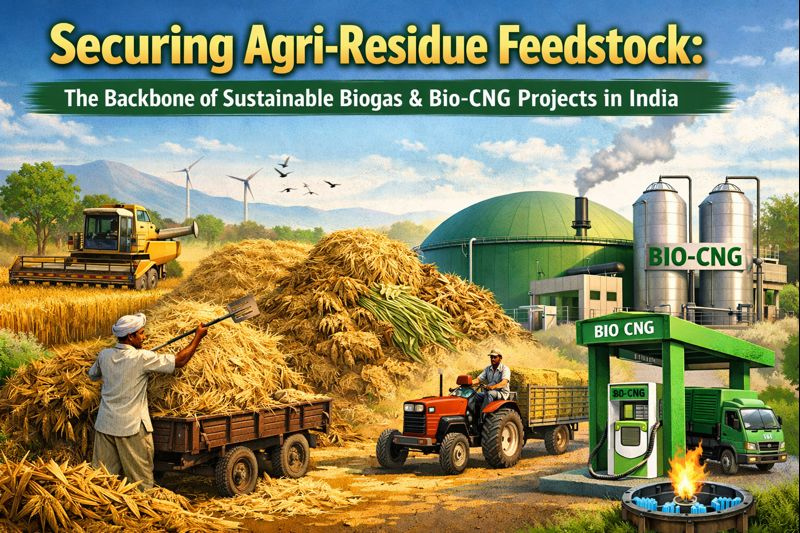
The quicker India turns into a circular economy and energy-independent nation, agri-residue feedstock becomes the single most important critical success factor for biogas and bio-CNG projects. Technology can evolve, more financing options can multiply, policies may remain dynamic-but it is good quality feedstock that separates real long-term viable projects from the rest-inconsistent availability of good quality feedstock separates real long-term viable projects from the rest.
For developers, municipalities and industries investing in biogas plant solutions in India, feedstock was earlier considered at the operational level. Gradually it moved up to the strategic decision level.
Why Agri-Residue Feedstock Matters in India
India generates millions of tonnes per year of agricultural residue from paddy straw and press mud to Napier grass and market waste. Unmanaged, this biomass is responsible for pollution, open burning, and landfill pressures. Managed properly, it becomes a powerful input for anaerobic digestion systems for organic waste in India.
A stable agri-residue supply ensures a predictable biogas yield, higher plant uptime, and faster ROI for Bio-CNG projects with reduced dependency on single waste streams. That is why top biogas plant manufacturers in India emphasize feedstock planning from the very first day.
Common Agri-Residue Feedstocks for Indian Biogas Plants
The biomass energy solutions project in India runs successfully on a diversified feedstock basket, such as:
🌾 Paddy Straw & Crop Residue
Effective paddy straw management for bioenergy in India helps address stubble burning while supplying lignocellulosic biomass for digestion (with pre-treatment). Such high-yield crops of Napier grass for biogas production in India are increasingly adopted for captive and large-scale projects due to year-round availability. Integrated with municipal organic waste management solutions in India, these feedstocks enhance methane yield.
Agro-industrial Residues
Press mud, spent wash and food processing waste are ideal inputs for biomethanation plants of municipal & industrial waste in India.
Challenges in Securing Agri-Residue Feedstock
Despite abundance, projects often fail due to poor feedstock planning. Common challenges include:
- Seasonal availability of agricultural waste
- Fragmented farmer networks
- Logistics and transportation costs
- Inconsistent waste quality
- Lack of long-term supply contracts
This is where top biogas consultancy services in India and EPC expertise become critical.
ORS Approach: Feedstock-First Project Design
At Organic Recycling Systems (ORS), feedstock security is addressed as a primary engineering and commercial input rather than an afterthought.
🔍 Waste Audits & Feedstock Mapping
ORS conducts waste audit services for Indian industries and agricultural clusters to quantify the volume, quality, and seasonal variation of wastes.
📊 Feasibility & Yield Assessment
Every project is accompanied by a CBG & biogas plant feasibility report in India to ensure that technological choice aligns with actual availability of feedstock.
End-to-End EPC Execution
Being one among the trusted set of bio-CNG plant EPC companies in India, ORS involves feedstock planning right from the design stage through construction and up to commissioning.
For developers and EPC partners, it falls under a component of their checklist on feedstock assurance which directly links to financing, offtake agreements, or even all regulatory approvals. Top engineering companies working on waste-to-energy projects across India have now started implementing the following practices:
- Long-term aggregation at farmer level
- Local sourcing to reduce logistics
- Decentralized pre-processing units
- Technology that can work with mixed feedstock
More so for projects being implemented in these regions- Maharashtra, Gujarat , Karnataka , Telangana and also urban clusters like Mumbai Navi Mumbai.
Regional Advantage: Maharashtra & Western India
Regions like Mumbai, Navi Mumbai, and Gujarat-all having strong municipal structures in place besides being thickly industrialized, are emerging as hubs for renewable energy solutions for waste management in India.
ORS actively supports:
- Organic waste recycling in Navi Mumbai
- Urban and industrial projects as a waste management company in Mumbai
- State-wide initiatives aligned with national bioenergy missions
- Feedstock Security = Bankable Green Energy Projects
For Indian policymakers, it is not merely a question of the availability of waste to secure agri-residue feedstock. It is also in developing projects that are bankable, scalable, and ready for regulation.
Be it at your municipal plant or industrial Bio-CNG unit or hybrid agri-waste facility, working with an experienced green energy solutions company in India will make your project a success.
Conclusion
Winners in India’s maturing bioenergy landscape will be those with secured feedstock. A structured approach to combine agricultural waste, municipal organic and industrial residues needs strong EPC execution.
With core strengths among engineering companies in Mumbai for waste-to-energy, ORS continues to make projects future-ready, reliable and sustainable across India-from North to South; East to West.
Connect with Organic Recycling Systems
📞 Contact: 022-41702222
✉️ Email: info@organicrecycling.co.in
Frequently Asked Questions (FAQs)
1.What is agri-residue feedstock in biogas plants?
Agri-residues mean all forms of crop residues left in the field after harvesting, primarily paddy and wheat in the northern states. Other secondary residues are maize, sugarcane, pulses, bajra, jowar, oilseeds/cakes, cotton stalks etc. Technically it may be defined as lignocellulosic biomass which contains carbohydrate polymers: cellulose & hemicellulose and an aromatic polymer: lignin that provides strength to the plant structure.
Agri-residue feedstock refers to agricultural by-products such as paddy straw, Napier grass, crop residues, and agro-industrial waste used as input for biogas production. These are most preferred in availability and renewable nature solutions of biogas plants in India.
2.Why is feedstock security critical for biogas and Bio-CNG projects?
Consistent feedstock shall bring about steady gas output, consistent performance of the plant, and long-term financial viability. This is also one of the most important aspects for developers working with any bio-CNG plant EPC company in India to achieve security on feedstock to attain planned capacity utilization.
3.Which agricultural residues are commonly used for biogas production in India?
Common feedstocks include paddy straw, Napier grass, market waste and food processing waste along with press mud. These support highly efficient systems of anaerobic digestion for organic waste in India when properly pretreated and blended.
4.How does Paddy Straw Management support bioenergy projects?
Effective paddy straw management for bioenergy in India reduces open field burning by converting surplus crop residue into renewable energy through biomethanation and Bio-CNG production.
5.How do waste audits help in securing feedstock?
Waste audits are the primary step toward feedstock security. Most organic waste generators underestimate or overestimate their own quantities of waste generation. A detailed audit followed by documentation is a confidence-building measure for both the organic waste generator and the biogas project developer to enter into a long-term organic waste supply agreement, which will further assist in financial closure from banks and other investors.
Waste audits help in identifying the quantity, quality, and seasonal variation of available waste. Waste audit services for industries in India are mostly a primary step towards designing efficient organic waste processing plants in India.
6.Can agricultural waste be combined with municipal organic waste?
Yes. It helps improve the efficiency of digestion while reducing a risk on the supply side if agri-residue is blended with municipal organic waste. This approach is widely used in biomethanation plants for municipal & industrial waste in India.
7.How do EPC companies participate in feedstock planning?
EPC companies align and integrate the assessment of feedstock with plant design, logistics of feedstock, and selection of technology. Reliable EPC company services for biogas & CBG plants in India shall ensure engineering and execution integration to address variability in feedstock.
8.What is the mode of evaluation for feasibility on feedstock for Bio-CNG projects?
Feedstock feasibility is carried out by field surveys, waste characterization, yield analysis, and logistics planning. All this information is compiled as a detailed CBG & biogas plant project report in India for investors and lenders.