

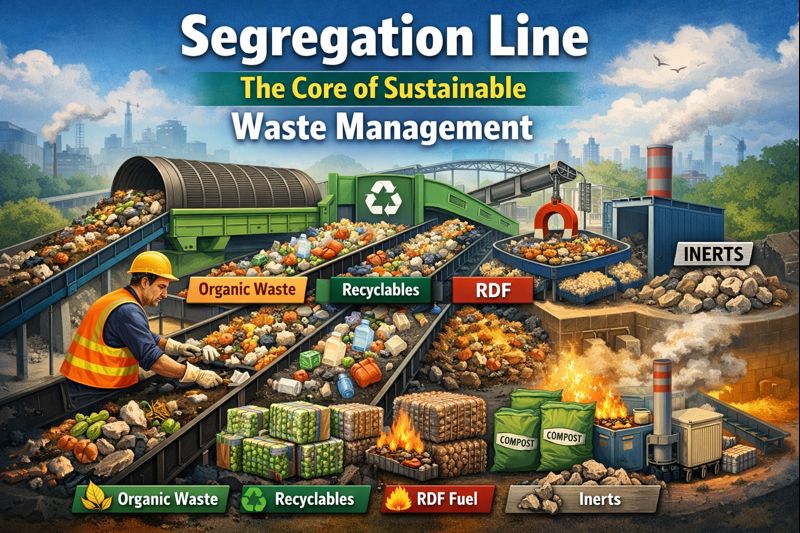
Segregation Line: The Core of Sustainable Waste Management
Millions of tons of municipal solid waste are generated in India every year. Rapid urbanisation, increasing population have turned waste management into one of the most burning environmental issues in India. This report provides a summary guide on segregation lines or systems that play an important role at the core of any sustainable waste management system.
A good segregation line will separate the mixed waste into organic waste, recyclables, inert material, and RDF as valuable fractions. This is the baseline for recycling, composting and biogas or waste-to-energy projects.
Organic Recycling Systems (ORS) is one of the best segregation line manufacturers in India. ORS provides advanced, reliable, and scalable segregation line solutions for municipalities, industries, and waste-to-energy developers. Having decades of experience in solid waste management with a clear understanding of Indian waste characteristics at all levels, with consideration to design, ORS delivers the most appropriate solution through its highly qualified team.
This on-page guide details segregation lines, their importance, technology, and applications. It also explains why ORS is a trusted partner for segregation line projects in India.
What is a segregation line?
A system or conveyor line where different types of waste are separated from mixed waste, either manually or through machines installed along the line at specific intervals.
A segregation line is defined as a mechanical or even partially automatic system in which mixed solid waste components are separated based on differences in size, weight, and density, inorganic and organic materials. The main objective of such segregation lines is to maximise resource recovery with minimum disposal to landfills.
Indian conditions always speak about the receipt of waste in its mixed form. A very effective segregation line for waste management will play out as an important actor within this mixed waste stream by bringing forth the values that can be attained from such a scenario.
Why the segregation line Is Critical for Waste Management in India
The success of any waste management or even waste-to-energy project lies hugely in segregation. In the absence of a proper segregation line, this is what happens to all waste processing plants: operational inefficiency, poor quality output products, and high cost of operations.
Key benefits of a segregation line:
- Improves recycling efficiency
- Enhances the quality of the organic fraction
- Reduces landfill dependency
- Produces high-calorific RDF
- Protects downstream equipment
- Improves project economics
A municipal solid waste segregation line enables the municipality to comply with the Solid Waste Management Rules, 2016. Apart from this, an unsustainable way of handling waste is also achieved.
Role of Segregation Line in Municipal Solid Waste (MSW) Management
Indian municipal solid waste (MSW) is heterogeneous and difficult to process. ORS installs MSW segregation lines specifically engineered for Indian waste conditions.
Challenges in MSW Processing:
- High moisture content
- Mixed waste streams
- Seasonal variations
- Presence of inert material
A well-engineered segregation line for MSW addresses these challenges through customised screening, separation, and manual sorting stages.
ORS Segregation Line Solutions
Organic Recycling Systems (ORS) provides complete segregation line solutions, beginning with concept and design to installation, commissioning, and support.
Scope of ORS segregation line Services:
- Waste characterization study
- Segregation line process design
- Mechanical equipment selection
- Installation & commissioning
- Integration with composting/biogas/RDF plants.
Every ORS segregation line is engineered for the highest recovery with the least operational complexity.
Key Components of an ORS Segregation Line
A typical ORS segregation line consists of the following components:
- Waste Feeding System
- Feeder
The feeder ensures consistent and regulated delivery of waste to the segregation line.
- Bag opener/primary shredder
It breaks the plastic bags and loosens the waste for effective separation.
- Trommel screen
The trommel screen separates the material by size, with a focus on the organic fraction.
- Disc screen Vibratory screen
The vibratory screen allows for the further separation of light and heavy materials.
- Magnetic separator
The magnetic separator effectively recovers ferrous metals.
- Air density separator
Light plastics, films, and other materials were separated effectively from heavier ones.
- Manual sorting stations
The manual sorting stations facilitate quality control and enable the recovery of valuable recyclables.
- Conveyor Systems
Material transfer from one end to another across the line is made easy and smooth.
Each component in the segregation line is selected based on waste characteristics and plant capacity.
Comparison, Automated Segregation Line & Manual Segregation
ORS provides automated segregation lines as well as semi-automated solutions based on project requirements.
Automated Segregation Line
High throughput capacity, reduced manpower, consistent performance, and lower long-term operating cost
Manual Segregation Line
Suitable for smaller capacities. Higher manpower requirement, lower capital cost
ORS will recommend an optimal waste segregation line after conducting a detailed analysis of the wastes and assessing what is feasible.
Dry Waste Segregation Line
- A dry waste segregation line focuses on the recovery of recyclable materials such as plastics, paper, cardboard, and metals. ORS designs dry waste segregation lines for:
- Material Recovery Facilities (MRF)
- Recycling centers
- Urban local bodies
Such lines increase the recycling rate and generate income from recovered materials.
Composting & Biogas Plants
The line of segregation is directly proportional to the input. High-quality clean organic waste output, either high-quality compost or biogas. Besides a continuous supply of clean organic feed free from plastics and other inert contamination, a separation line also brings added benefits to the organic waste processing industry.
Higher Biogas Yield!
Apart from increasing the biogas yield with improved quality of compost, reduced downtime, and low maintenance cost, this system has many advantages that make it preferred by the maximum number of clients.
ORS supplies segregation lines integrated with composting or biogas systems.
Segregation Line for Waste-to-Energy Projects
Projects on waste-to-energy rely on the quality of RDF. A good segregation line for waste-to-energy will ensure:
- High calorific value RDF, consistent fuel quality
- Reduced processing losses
- RDF-based waste-to-energy projects across India widely use ORS segregation lines.
- Customised Segregation Line Design for Indian Conditions
Indian waste composition varies significantly across regions. ORS designs each segregation line based on:
- Waste composition study
- Moisture content
- Capacity requirements
- End-use of segregated fractions
This customised approach makes ORS a preferred segregation line manufacturer in India.
Compliance with Solid Waste Management Rules
ORS segregation lines are designed to support compliance with:
- Solid Waste Management Rules, 2016
- CPCB & SPCB guidelines
- Municipal tender specifications
ORS thus is a dependable associate for government and municipal projects.
Why Choose ORS as Your Segregation Line Manufacturer in India
Organic Recycling Systems possesses:
- Years of experience in waste management
- Proven installations running successfully
- In-house engineering capabilities
- Custom-designed solutions
- Integration with waste-to-energy & biogas plants
ORS has been known as a trusted segregation line manufacturer in India for private as well as public sector projects.
Application of the ORS Segregation Line
- Municipal solid waste processing plant
- Material recovery facility
- Composting plant
- Biogas plants
- RDF & waste-to-energy projects
- Industrial waste processing
Future of Segregation Line Technology in India:
With increasing focus on the circular economy and sustainability, segregation line technology will play a critical role in
- Resource recovery
- Renewable energy generation
- Reduction of landfill burden
- Climate action initiatives.
ORS is continuously innovating and upgrading segregation line technology to meet future requirements.
Conclusion
A segregation line is not just equipment. It is the core process of sustainable waste management and recovery from waste operations, municipal solid waste processing, or waste-to-energy projects. The efficiency in operation and success of a segregation line often form the result of an analysed detail that mostly goes unnoticed.
FAQs
Q1. Are segregation lines engineered to process mixed municipal solid waste in India?
Yes, the segregation lines are basically engineered for heterogeneous and high-moisture municipal solid waste that suits perfectly Indian conditions.
Q2. What type of waste is processed on the segregation line?
Depending upon system design, organic waste, plastics, paper & cardboard, metals, and inert material can be processed on a segregation line.
Q3. What is the difference between automated and manual segregation lines?
Automated lines have higher capacities, provide a consistent output, and in the long term prove to be less expensive than manual systems, which are better suited for small operations with low initial investment.
Q4. Why is RDF quality dependent on segregation lines?
A better segregation line gives a good RDF with a higher calorific value and less contamination to improve the efficiency of waste-to-energy projects.
Q5. How are segregation lines custom-designed for different waste compositions?
Segregation lines are to be installed based on the type or composition of waste, its moisture content, capacity per hour in processing, and finally, by end-use of segregated materials.
Connect with Organic Recycling Systems
📞 Contact: 022-41702222
✉️ Email: info@organicrecycling.co.in