

India’s transition to renewable energy is no longer restricted to solar and wind power. The next phase of decarbonisation is being driven by renewable gases that can easily blend into the existing fuel infrastructure. Among those, compressed biogas from Napier grass is shaping up as one of the most attractive and commercially viable routes for clean mobility, industrial decarbonisation of the hard-to-abate sectors, and driving the rural bioeconomy.
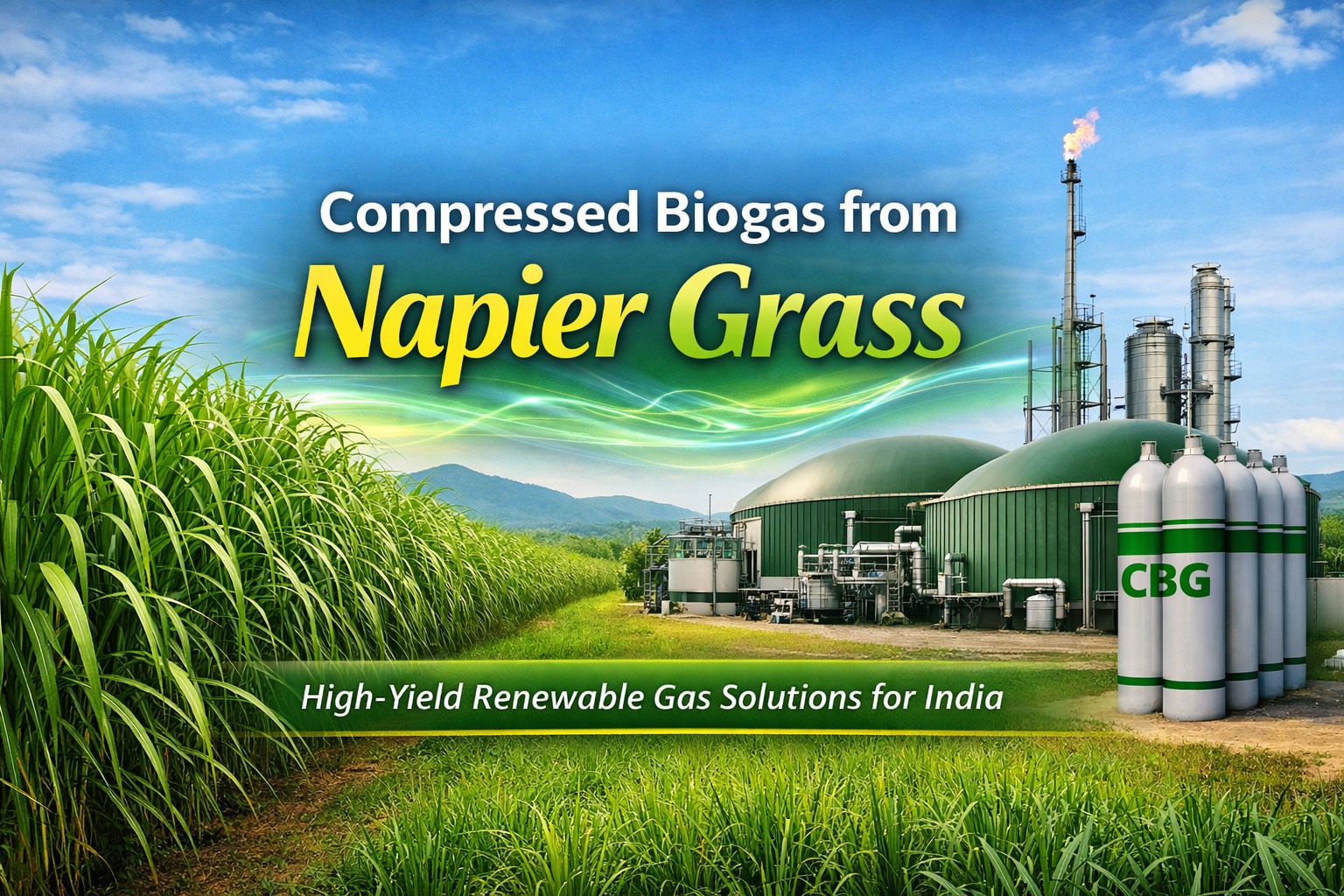
As the need for clean transport fuels grows and city gas distribution networks are rolled out across the country, the requirement for reliable, high-yield, and scalable feedstock becomes essential. Agricultural residues are seasonal. The composition of municipal solid waste varies widely. Industrial organic waste streams are erratic. Instead, Napier grass provides a homogenous, predictable and scientifically manageable biomass capable of sustaining long-term compressed biogas (CBG) production at a commercial scale.
With considerable experience in bioenergy engineering, feedstock R&D, and turnkey delivery, Organic Recycling Systems Limited (ORS) has pioneered energy crop-based biogas technologies to deliver yield performance certainty, process stability, and financial bankability for developers and investors. This guide delves into the agronomy, engineering, economics, sustainability, policy alignment, and future development of compressed biogas from Napier grass in India. Strategic Need for Compressed Biogas in India’s Energy Mix.
Compressed biogas is the name given to a purified biogas that has been upgraded to a concentration of above 95 per cent methane. This means that compressed biogas is calorifically and functionally similar to fossil CNG, which can be used to power public transport fleets, heavy commercial vehicles and industrial heating. It can even be injected into gas grids.
India’s roadmap envisages a large-scale replacement of imported fossil fuels with locally produced renewables on the supply side. Renewable gases produced from biomass play a key role, as they are deliverable, unlike wind and solar generation. CBG uses an existing CNG grid and does not require brand new distribution networks.
Napier grass as a dedicated energy crop overcomes the biggest Achilles heel of biogas: scarcity of feedstock. The more reliable that feedstock is, the less risky a project appears, the simpler it becomes to find financing, and the easier it becomes to run a project over the long term. What is Napier grass? Napier grass, elephant grass or Pennisetum purpureum is a tropical grass that is cultivated throughout India. Once known as a fodder grass, it now has been elevated to the status of a bioenergy crop.
The agronomic characteristics of Napier grass, such as its fast growth, availability for several cuttings each year and adaptability to different soils, would make it a suitable feedstock for CBG production, with yields under controlled irrigation and scientific cultivation of between 250 and 350 tonnes per hectare per annum depending upon climate and agricultural practice.
Napier grass’s most important benefit is its regrowth — it does not die out after each ‘harvested’ cut, allowing constant regrowth and sustained biomass supply for a few years after establishment, greatly lowering cultivation cost/tonne and greatly favouring economics of feedstock. Napier grass also sequesters additional carbon from the atmosphere through photosynthesis, which is an almost closed carbon cycle during conversion to biogas.
Why Compressed Biogas from Napier Grass Is Gaining Commercial Attention
The commercial attractiveness of compressed biogas from Napier grass is in its predictability. Investors and financiers assess renewable energy projects on the basis of feedstock risk and tonal output variability. Napier grass cuts down risks in both those areas.
Municipal solid waste projects face the difficulty of varying organic fraction content. Paddy straw is a seasonal crop and dependent on the timing of harvests. Food waste streams are erratic and depend on the tendencies of eating in urban centres. Napier could be grown against contract farming arrangements, giving an assured supply on relatively long-term contracts.
This structured approach enables developers to predict gas production more reliably. The more predictable the yield of methane, the better the revenue modelling, and the better the ability to service debts. With that sell-side investment know-how, energy crop STD CBG projects frequently walk with stronger bankability profiles when designed and engineered correctly. The Science of Biogas from Napier Grass: Compressed biogas from Napier grass is derived from the conversion of lignocellulosic biomass into methane from biological digestion in anaerobic conditions. The basis of which are biological populations which affect decomposition of organic material. Napier grass is made up of cellulose, hemicellulose and lignin. Cellulose and hemicellulose are easily digestible, while lignin tends to act as a barrier to organisms.
This is the reason for pretreatment and feedstock optimisation being extremely important for high methane yields.
It all starts with size reduction. Chopped grass has a greater surface area accessible to microbes where cellulose fibres are located. Moisture is adjusted for the best growth activity of microbes, and possibly biological or enzyme pretreatment of material can occur to aid in fibre breakdown and methane production.
Within the digester itself, the four biological stages occur: hydrolysis, acidogenesis, acetogenesis and methanogenesis. For these stages the temperature, pH and retention time must be closely controlled, and great care in the design is necessary to avoid inhibition of the process by an unstable action of the biomass.
Engineering experience is essential in taking projects from the laboratory to commercial plants. For example, feedstock analytics, laboratory work and process simulation are integrated into plant design by experienced firms of the calibre of Organic Recycling Systems Limited.
Engineering Design Considerations for Napier-Based CBG Plants
The operation of a CBG plant is, as mentioned above, one of engineering accuracy. Digesters must be such as to accommodate the quantity of biomass put in day by day with sufficient hydraulic retention time, with temperature control equipment being required to give mesophilic or thermophilic conditions, again according to design.
Gas upgrading systems eliminate carbon dioxide, hydrogen sulphide, and moisture. The resulting gas must be purified enough to reach methane production standards prior to compression. Automation systems constantly monitor for digester pressure and gas composition, as well as ensure the feed material is optimally loaded into the digester for the best yield.
Napier grass projects would also need serious thinking about feedstock handling systems. How to store biomass? What preprocessing units do we need? If everything is not well mechanically designed, we could face operational bottlenecks that take a hit on plant performance.
ORS has evolved integrated solutions to generate consistent gas via clever feedstock R&D and advanced plant automation. Napier-based projects deliver higher yield and lower downtime thanks to their knowledge of CBG plant engineering and design. Yield Optimisation and Feedstock R&D To ensure improved methane yield from Napier grass requires ongoing research regarding the harvesting period, moisture content, fibre composition, pretreatment, and so on.
Timing when to harvest grass improves the proximity between biomass amount and biomass digestibility. Too mature grass may have higher lignin concentrations, causing reductions in methane potential, though too immature grass may help on the whole to reduce the total biomass amount produced per hectare of feedstock, ultimately reducing the mass that may be digested properly. Laboratory testing aids hugely in determining BMP; through routine analysis of feedstocks, developers may optimise retention time, loading rate and coproduction if mixed with other substrates.
Organic Recycling Systems Limited has in-house feedstock R&D capabilities to provide scientific yield forecasts and process optimisation. This research helps underpin the economics of large Napier-based CBG projects. Economic Analysis and Financial Viability Compressed biogas from Napier grass can be highly profitable from a long-term perspective, given the correct structuring. Feedstock cost is cheaper than fossil fuel imports and is somewhat insulated from price fluctuations through contract farming.
Revenue streams:
CBG sales to oil marketing companies or city gas distributors, the sale of bio-fertiliser generated from digestate and potentially carbon credits. Combined with favourable government schemes, the project IRR is severely attractive. Energy crop models also create rural economic opportunities, as farmers have a guaranteed offtake and stable income, whilst developers have long-term access to biomass supply.
Financial backing for projects is dependably accessible based on feedstock security, offtake arrangements, engineering validity, and policy fit. CBG plants getting eucalyptus through offtake agreements, engineered by seasoned EPC players, usually score well on these criteria. Environment and sustainability benefits This CBG derived from Napier grass offers measurable environmental benefits. The carbon released when combusted is similarly taken up when that crop – itself a net carbon sink – is growing, delivering a near-zero carbon cycle.
Unlike fossil fuels, Napier-derived CBG can reduce greenhouse gases and avoids the risk of methane release from uncontrolled or uncontained decomposition of a significant proportion of the earth’s vegetation.Rather, the controlled anaerobic digestion of the processed Napier biomass ensures the maximum production of methane gas. Finally, the use of digestate enhances soil quality by the accumulation of organic carbon and nutrients, thus reducing the reliance on chemical fertilizers.
The growth of Napier grass on marginal land safeguards the soil from erosion and raises the productivity of marginal land without encroaching on food crops and at the same time provides a fair return to the owner of the land as opposed to encroachment on food crops.
Policy Fit and National Renewable Targets Carbon intensity reduction, energy security enhancement, and rural income increase are among India’s renewable pledges. CBG will happily tick those boxes for India. Renewable gas means cleaner cities. Renewable gas in India delivers energy security and reduces import affordability. The energy crop-based model empowers farmers and gives them a slice of the bioenergy value chain.
Developers operating alongside a proven technology partner like Organic Recycling Systems Limited are better able to adjust to changing regulations and expectations regarding performance. Risk Management and Assurance of Continuity Every route in renewable energy has its risk; however, Napier’s CBG projects solve many challenges faced by even the most experienced biogas providers. Uncertainty surrounding supply is reduced with a structured plantation. The supply chain ensures a carve-out for a solid flow of biomass in.
Reducing process risk: sophisticated automation and monitoring reduce process risk. Gas upgrading technologies ensure that the methane produced remains pure, and careful digester design prevents overloading and microbial inhibition. Longer term, maintenance scheduling, spare part management, and performance analytics also help maintain reliability. The future of Napier grass-based renewable gas As India’s renewable gas blending targets and industrial decarbonisation drive increase, there will be a strong demand for high-quality CBG – Napier grass is emerging as a promising bioenergy crop.
Looking ahead, we could witness the development of highly advanced biological carbon capture technologies, AI-driven yield optimisation, and hybrid feedstock blending models. Current research efforts should continue to enhance efficiency and cost competitiveness in methane yield. Those companies that align agronomy with engineering expertise will be pioneers of this regime. Organic Recycling Systems Limited continues to invest in innovation and will be a significant contributor to the renewable gas ecosystem in India.
Conclusion
Compressed Biogas from Napier Grass:
Sustainable Powertrain. The Napier grass/compressed biogas combination represents a powerful combination of agriculture with engineering, sustainability and clean mobility. The potential for predicted feedstock supply, high yield of methane, economic viability and a wealth of environmental benefits are stacked in favour of this source of renewable combustibles.
Through innovative feedstock and technology research, continuous prototyping and advanced engineering, and turnkey EPC execution for clients, Napier will be responsible for enabling India to grow and fulfil the increasing expectation of renewable gas; and with industry-leading organisations such as Organic Recycling Systems Limited at the helm, the realisation of an indigenous, self-sufficient renewable gas economy is well underway.
Compressed biogas produced from Napier grass is not only a clean fuel option; it is an energy source that is future-proof and can help advance the sustainability and energy independence agenda in India. Partner with ORS to assess the technical, commercial, and scalability viability of your Compressed Biogas from Napier Grass project. Build a future-ready renewable gas asset for the green transition of India and create commercial value in the process!
Frequently Asked Questions:
1. What is compressed biogas from Napier grass?
Ans: It is purified biogas produced from Napier grass and upgraded to high methane content, similar to CNG.
2. Why is Napier grass used for CBG production?
Ans: Napier grass provides high biomass production, multiple harvests in a year, and a consistent supply of feedstock.
3. Is CBG from Napier grass equal to CNG?
Ans: Yes, upgraded CBG has a similar methane composition and calorific value to CNG.
4. Does Napier grass improve project bankability?
Ans: Yes, it does, as the consistent supply of feedstock minimises project risks.
5. What happens to the by-product after digestion?
Ans: The by-product is converted into organic biofertilizer.
Leave a Reply