

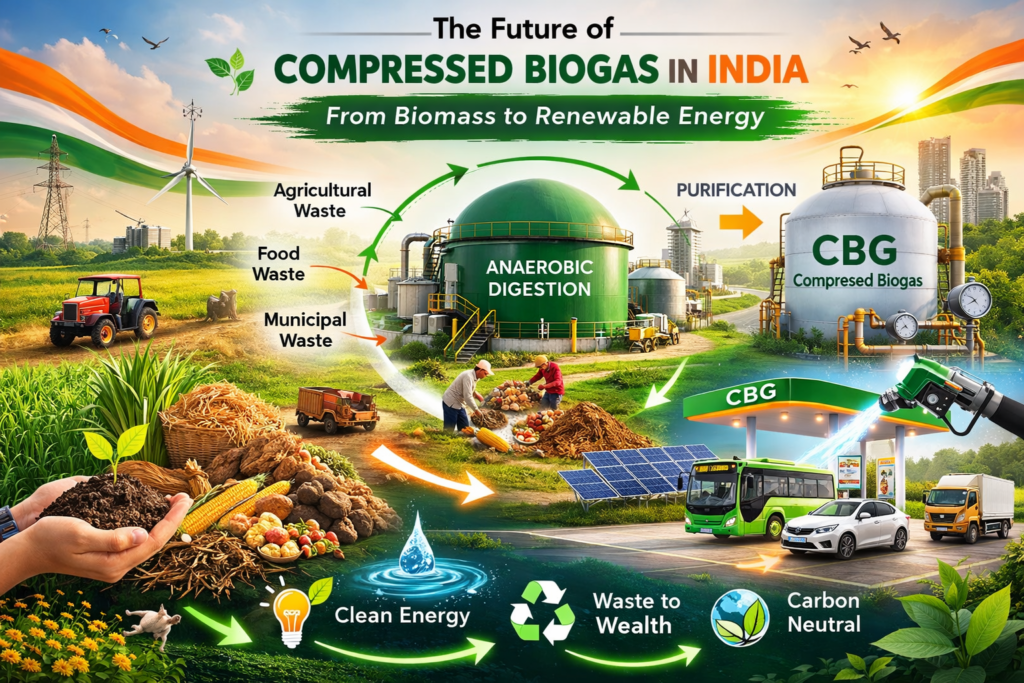
The Future of Compressed Biogas in India From Biomass to Renewable India’s solution for waste to energy India is making its voice heard and it is opting for renewable energy solutions that cut fossil-deficit tail and also helps turnout waste of any description in the country. One solution that far seems rather good on paper is compressed biogas (CBG), a renewable gas fuel made from organic waste and biomass. a renewable fuel produced from organic waste and biomass. The product has seen increasing growth as the government has taken steps with programs like the SATAT Scheme, to nudge the country’s energy requirements.
The successful construction of CBG plants requires experienced engineers with appropriate technologies and expertise in biomass. Hence, industries, municipalities and energy developers are looking for a competent compressed biogas plant manufacturer in India who has the skills to design and build efficacious waste-to-energy infrastructure.
These projects are developed by professional CBG plant EPC companies in India providing complete engineering, procurement & construction of the project.
Understanding Compressed Biogas and Its Role in the Energy Sector
Compressed biogas is derived from the organic waste by the process of anaerobic digestion from agriculture, municipal solid waste, food, and energy crops: “Microorganisms digesting artifcial organic tissue without air produce biogas made up of mainly methane and carbon dioxide”.
Following the purification and upgrading of the gas using advanced CBG purification technology, the methane concentration increases significantly.
The gas is compressed into compressed biogas, which can be exploited as a renewable transport fuel similar to compressed natural gas. Heightened appetite for renewable gas from waste has prompted a new industry in India around the companies that supply advanced CBG technology, focusing on plant automation, better digestion efficiency, and optimized plant performance through sophisticated monitoring.
Napier Grass as a High Yield Feedstock for CBG
One of the most promising bioenergy plants used to generate biogas for reproduction as compressed biogas is Napier grass, a quickly growing plant with all-year-round supply viability that can give high biomass yields while producing a sizeable methane out put due to its high cellulose content during anaerobic digestion.
A source of biogas via Napier grass is under study, where a variety is planted for larger-scale bioenergy crops together with potentially better cultivation and digestion methods. Compressed biogas depending on Napier grass has a host of advantages, such as consistency of its supply, high, and not relying on seasonal agricultural residues.
Different types of biomass can be used to produce compressed biogas based on regional availability and agriculture. Of particular importance is feedstock research and development because the quality and make up of the biomass feedstock has a direct impact on gas production yield. Feedstock Type, Source, Advantage for CBG Production: Napier Grass, Energy crop, High biomass yield and continuous supply; Paddy straw, Agricultural residue, Helps reduce crop burning and pollution; Municipal solid waste.
Urban organic waste: Trash to Renewable Energy Food Waste: Hotels and households Agricultural Residues: All crop by-products, particularly crop residues eg paddy straw hydrolysis bioenzyme pretreatment of agricultural residues are technologies that are related to how these types of biomass can be broken down to produce energy in the form of CBG.
Advanced Technologies Used in Modern CBG Plants
Other modern compressed biogas plants developed concepts for improving digestion and gas yield. Of interest is India’s dry anaerobic digestion systems allowing the high-solid organic waste streams usually emitted in that country to be digested with minimal wash water.
Plants with advanced capabilities like the DRYAD system can “dial-in” a more stable operation and produce more methane from complex biomass. At the same time, CBG plants’s automation solution allows plant operators to read digesters, gas composition and feedstocks live from the plant Facebook.
These systems promote CBG yield optimization and long-term operational efficiency for large-scale plants. Other technologies that are emerging include biomass torrefaction, municipal solid waste torrefaction, and BM-Alg technology.
Turnkey CBG Plant Solutions and EPC Engineering
A successful compressed biogas plant is backed with solid engineering, project planning, and technology. A reliable engineering company for CBG provides complete turnkey CBG plant solutions that cover the project from start to finish. This includes feedstock analysis, plant engineering and design, construction, installation, and commissioning. A good CBG plant process safely and efficiently produces quality gas.
Firms like Organic Recycling Systems Limited focus on implementing cutting-edge bioenergy projects and offer integrated EPC to large biogas plants.
The Role of the SATAT Scheme in Expanding CBG Projects
The SATAT initiative launched by the Government of India aims to accelerate the production of compressed biogas across the country. Under SATAT, the private developers can set up CBG plants and furnish renewable gas to the distribution networks. Numerous CBG projects under the SATAT initiative are presently being developed based on agricultural waste, municipal waste and dedicated energy crops. The projects also aid rural development, waste management systems and help the country in meeting the renewable energy goals.
A SATAT scheme CBG developer partners with engineering firms, technology providers and waste management companies to execute such projects. Further enlisting bioenergy technologies beyond compressed biogas Bioenergy innovation is moving quickly and compressed biogas is only part of the puzzle. Researchers are also looking at further s outposts to use successful techniques such as biomass to rDME and biomass to sustainable aviation fuel.
Technologies such as Biological Carbon Capture and Utilisation (BioCCUS)
Systems are being developed to capture carbon dioxide produced during biogas generation from energetic waste treatment plants (especially anaerobic digestion), followed by the conversion of that carbon dioxide into useful products. Such systems are contributing to the reduction of greenhouse gas emissions while increasing the sustainability of bioenergy plants. Waste to Energy and the Future of Renewable Gas in India Waste-to-energy technology is a becoming an integral factor in India’s long-term clean energy transition. Converting organic waste to renewable gas is decreasing landfill waste and lowering methane emissions along with providing new economic opportunities.
A modern waste to energy cleantech company in India concentrates on technologies that convert waste streams into valuable energy resources. Generating green energy from municipal waste not only contributes to cleaner cities, but also helps us to move towards more sustainable waste management practices. Compressed biogas also contributes to the sustainable mobility with biogas, as vehicles powered by CBG produce substantially fewer emissions than traditional fossil fuels.
Conclusion
Compressed biogas is becoming known as the answer to our energy/waste problems. Anything from farm residues to municipal waste to high energy yielding crops like Napier grass can now be turned into a clean renewable fuel.
With strong policy support from the SATAT Scheme and continuous technological innovation, the demand for advanced CBG plant engineering and bioenergy infrastructure will continue to grow.
Firms such as Organic Recycling Systems Limited are making this journey with next-gen bioenergy tech and vast industrial schemes to ‘transform’ biomass into renewable gas. As India starts its journey onto a circular economy and sustainable energy, compressed biogas will be essential to harnessing clean, reliable energy out of waste.
Get in touch with the team at Organic Recycling Systems Limited. Specialists in CBG plant engineering, biomass processing and renewable gas technologies, the company helps industries, municipalities and developers build projects to realise her bioenergy.
Frequently Asked Questions (FAQs)
- What is compressed biogas (CBG)?
Compressed biogas is a renewable fuel produced by the anaerobic digestion of organic materials including agricultural waste materials, food waste, municipal (landfill, sewage) waste, etc. The gas produced is further purified and compressed to create a clean fuel for use (like natural gas) on transport and as industrial energy for example.
- What materials can be used to produce compressed biogas?
CBG can be derived from a wide array of organic feedstocks from animal manure, municipal and food waste and agricultural residues to dedicated bioenergy crops like Napier grass. All are metabolised to produce dense gas in a biogas plant.
- Why is Napier grass considered a good feedstock for biogas production?
Napier Grass is a fast growing bioenergy crop. It has a high yield potential. With high organic matter it is likely to produce considerable methane during anaerobic digestion and is thus a reliable feed for continuous biogas generation.
- What is the SATAT scheme and how does it support CBG plants?
SATAT (Sustainable Agri Transport through App-based Transportation) scheme is a government initiative launched for promoting the production and use of CPBG (Compressed Biogas)|in India. The Scheme targets setting up CBG plants by private companies/developers and supplying renewable gas for transport and energy applications.
- What part of this project is played by the EPC company in a CBG plant?
All “Waterside c construction” of the biogas plant, i.e. all design and construction as well as plant design, installation of equipment, project management and commissioning to ensure the plant.
Leave a Reply