

The Future of Sustainable Fuel: Producing Clean Energy from Waste
Every day huge amounts of organic waste come from agriculture and food industries and people in cities—measured in millions of tons. In the past a lot of this generated toxic pollution basically from bacteria breaking down much of it and dumping methane into the atmosphere. But in the hands of modern bioenergy technologies, this waste is turned into a renewable fuel.
Introduction to Biogas and CBG
The biogas production process is one of the concepts to recycle waste and convert it to useful energy. Using some engineering and biological techniques to convert the organic waste left in the world, like agricultural waste, and even crops like Napier grass into Compressed Biogas (CBG)!
Today, CBG plant EPC companies in India are creating technologies that will enable the above industries and municipalities to produce renewable gas from waste, enabling India to become energy independent at a later date and reduce emissions in the near term. CBG is purified biogas, compressed and used as a clean fuel like natural gas.
When purified and upgraded to remove impurities like CO2, moisture, and hydrogen sulfide, biogas is called compressed biogas. It resembles natural gas, or as an industrial fuel.CBG has been actively promoted in India, with the launch of the SATAT scheme, encouraging the setting up of projects to promote the production of compressed biogas under. Projects under SATAT produce renewable gas from agricultural waste and biomass.
The Biogas Production Process
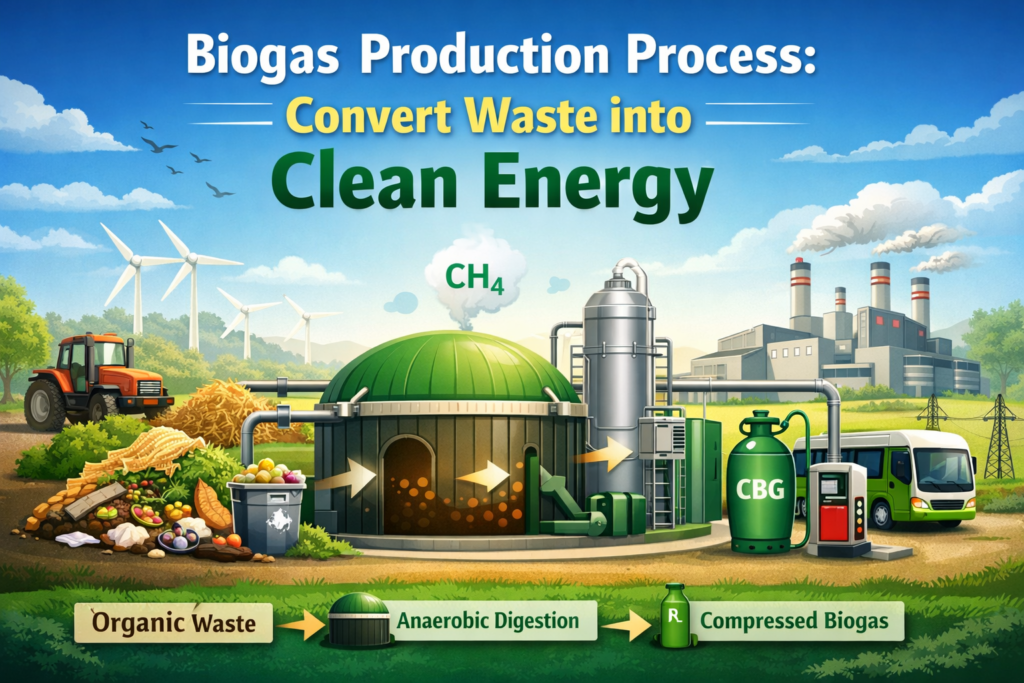
The science of turning organic waste into renewable energy. In the above graphic, advanced CBG plant engineering and design ensures the yield and efficiency of each stage of the process are maximized. 1. Feedstock Collection and Preparation Organic material like farm waste, municipal waste, and dedicated energy crops are collected and prepared for digestion in the first stage of the biomass-to-CBG conversion process.
1. Feedstock:
Research and development programs are working on Napier grass biogas production to improve the efficiency of large bioenergy plants. Feedstock pretreatment technologies such as bioenzyme treatment of agricultural waste and paddy straw hydrolysis break down tough plant fibers so that they are more digestible to microorganisms.
2. Pretreatment and Hydrolysis
Before the anaerobic digestion process begins, biomass is pretreated to make it more amenable to digestion, particularly where lignocellulosic biomass in the form of agricultural waste and energy crops is introduced to the digester. Biomass torrefaction and MSW torrefaction methods can greatly boost methane production, while some of the more sophisticated systems use methods such as BM-Alg technology that assist in speeding up the degradation of organic matter and increasing the amount of gas produced.
3. Anaerobic digestion
Anaerobic digestion (or biogas production, as it is often referred to) takes place during the heart of the biogas process. Many microorganisms degrade organic matter inside reactors devoid of oxygen. Investigated on projects in India is a new style of plant making use of dry anaerobic digestion systems. These are well suited to agricultural waste and municipal solid waste, as modern plants tend to be highly engineered.
4. Utilization of Biogas
This renewable gas can be used as transportation fuel, for industrial heating, or to generate power. Can also help with sustainable mobility through the use of renewable gas in the form of biogas and hence the reduction of fossil energy dependence.
5. Gas compression and storage
The upgraded gas is compressed and then stored in cylinders or injected into distant pipelines to make it marketable renewable gas from biogas. Most modern plants use CBG plant automation solutions, where sensors and actuators monitor the pressure, temperature, and quality of the gas in real time, allowing them to optimize the operational status of the plant and certify the quality of the fuel used.
Important Feedstocks for the Production of CBG
Numerous forms of biomass can be converted into biogas. On the other hand, some feedstocks provide higher yields and better financial returns.
| Feedstock Type | Source | Benefits for CBG Production |
| Napier Grass | Energy crop | High biomass yield and fast growth |
| agricultural waste | Crop waste like straw | Abundant and cost-effective |
| Municipal Solid Waste | Organic city waste | Reduces landfill waste |
| Food Waste | Restaurants and food industries | High methane potential |
| Bioenergy Crops | Specially cultivated plants | Consistent feedstock supply |
Advanced Technologies Improving CBG Production
Restaurants and food industries High methane potential Bioenergy Crops Specially cultivated plants Consistent feedstock supply Consistent supply of feedstock Energy crops such as Napier grass for biogas have gained some attention in recent years, as they produce a high-yielding feedstock, which can then steadily supply a CBG plant with the feedstock to ensure a stable and consistent gas production all year round. Cutting-edge Technology Improving CBG Production More recently, technology companies in India dedicated to CBG production are developing technology which further improves CBG production efficiency and sustainability. This includes Biological Carbon Capture and Utilisation systems (BioCCUS), which aid in capturing carbon emissions and converting them into useful products.
Role of EPC Companies in CBG Plant Development
Also of note are further advanced routes from biomass to rDME and also biomass to Sustainable Aviation Fuel (SAF), all demonstrating how waste-to- energy technologies can help deliver cleaner transport fuels. Moreover, engineering added value through optimising CBG plant process design, general sizing and CBG yield optimisation is also making sizeable biogas plants economic. Role of EPC Companies in CBG Plant Development A successful biogas project needs a good mix of engineering and technology and project execution skills. This is where CBG plant EPC companies in India come into the picture.
Companies managing the likes of biogas plants are known as EPC (engineering, procurement, and construction) and will handle: Feasibility studies; technology selection; plant engineering and design; equipment procurement; construction and commissioning; lots of companies match this brief these days and will deliver a turnkey deployment of a CBG plant so that investors and towns can turn rubbish into money.
Biogas and the Future of Renewable Energy
With global satiation for this worldwide appetite for sustainable energy, the importance of bioenergy will continue to grow. The technologies that are converting biomass to CBG are key to these aims of reducing waste, returning carbon to the soil, and creating clean fuel. India’s SATAT initiative is resulting in a proliferation of projects producing compressed biogas, CBG, across the country. Intended to propel the biogas sector, nearly 5,000 plants will be producing CBG from agricultural waste, municipal waste, and energy crops. Apart from the fuel, as by-products biogas plants also produce organic fertilizers.
Conclusion:
The process of biogas production is an example of how intelligent technology can convert waste into another form of renewable energy. Through better research on feedstock, new technology for digesting it, and purification technology, it is possible to convert biomass into compressed biogas.
Supported by a slew of trained engineering firms, along with several government initiatives like the SATAT scheme, India is on its path to be a world leader of cleantech in waste-to-energy solutions. Research continues into higher yield feedstocks like Napier Grass, BioCCUS, etc.; the future of renewable gas seems very bright.
Biogas is not merely an alternative fuel; it is a pathway to sustainable systems, an opportunity to clean our energy and surround us with less waste.
Frequently Asked Questions (FAQs)
What is the process of biogas production?
Biogas production is really all about making energy from waste, by collecting organic materials often referred to as feedstock; in other words, food waste and farm waste (to name a few) and then placing it all into a closed tank – digester, in which tiny micro-organisms act upon the feedstock; slowly eating it away without the presence of oxygen. The greener these little munchers get, the more biogas they will produce which can then be used for cooking, heating or generating electricity. In order for gas to be used efficiently and safely it must be cleaned by removing carbon dioxide as well as moisture and hydrogen sulphide. They may thereafter be upgraded into compressed biogas (CBG) and used as a clean transport and industrial fuel.
What is compressed biogas (CBG)?
Compressed biogas (CBG) is the purified biogas enriched in methane (> 90% methane) ; it is formed following the removal of unwanted gases and moisture and compressing the gas into suitable storage or transport cylinders. Compressed biogas is analogous to CNG and can be used as another fuel substitute for automobiles and in industry.
Which materials are used to produce biogas?
They have found use as feedstocks for producing gas from organic materials including agricultural waste, Napier grass, food waste, municipal solid waste etc. These feed stocks are commonly available and can readily be converted to energy. Of these, Napier grass is coming into prominence on account of the high yield and rapid rate at which it grows. Food waste also gives a high methane yield. The choice of feedstock depends on its availability, cost and the type of output desired.
Is the Biogas environmentally friendly?
Yes. Biogas helps in mitigating greenhouse gases in the earth’s atmosphere. This is because biogas removes methane from the environment, thus using it as a source of energy.
It being used in the disposal of organic wastes and at the same time producing organic fertilizers.
What does the SATAT scheme mean and why is it important?
In simple words, the CBG scheme ensures adequate users for the gas produced by businesses and entreprenuers in exchange for installing a CBG plant of their own. Oil marketing firms assure them that they will buy this biogas, which makes the venture less risky and creates confidence at the same time reducing pollution, managing waste better, and greening the mobility.
Can biogas be used as fuel for vehicles?
Once purified and compressed, biogas is referred to as ‘compressed biogas’ or CBG and has similar properties to CNG for use as a vehicle fuel. Existing CNG vehicles can use CBG, which requires little or no modifications.
Incorporating CBG into your fuel delivers savings, lowering emissions too, and it’s a greener arrive fuel altogether.
Benefits of Napier grass for biogas?
Napier grass is a GIANT, yield/acre stuff applies then; also a true energy crop therefore great big, lots of biomass scale stick/acre.
It also requires relatively low maintenance and ensures stable gas production throughout the year, making it a preferred feedstock for many CBG projects.
Reach out for more details:
Contact Us Organic Recycling Systems Limited.
Office No. 1003, 10th Floor, The Affaires, Plot No. 9, Sector-17
Sanpada, Navi Mumbai – 400705
Leave a Reply