

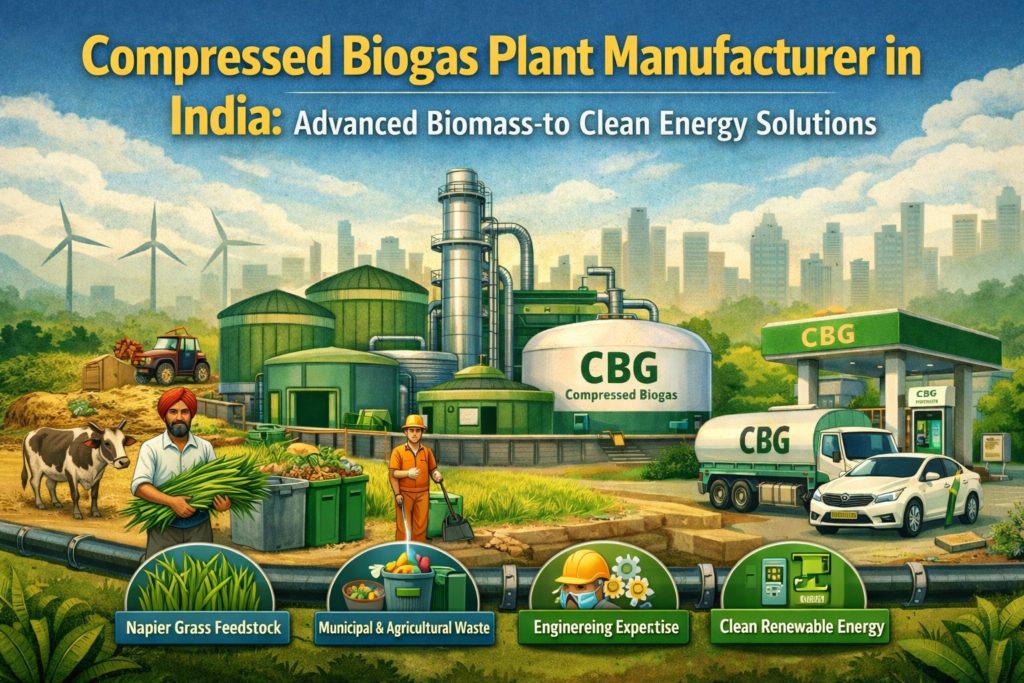
India is quickly heading towards a future with cleaner energy sources. As the country attempts to cut down fossil fuel use and strengthen the renewable energy framework of the nation, Compressed Biogas (CBG) is emerging as one of the greatest solutions. CBG is produced from organic waste and biomass, a renewable alternative that can power the transport sector, industries and even energy systems and reduce environmental pollution.
With industries, municipalities and energy developers working in increasingly larger clusters across India, partnering with an experienced compressed biogas plant manufacturer in India becomes vital. A competent manufacturer designs and engineers more than just a piece of equipment; they package an entire biomass-to-energy ecosystem to guarantee continued efficiencies, longevity and gas recovery.
Modern CBG plants are a far cry from the old biogas plants that used to occupy several plots of land. Such businesses looking to develop renewable gas infrastructure depend upon an experienced CBG plant EPC company in India to provide turnkey CBG plant projects, going from concept design to plant commissioning and operational support.
The Rise of CBG Projects Under the SATAT Initiative
The compressed biogas sector in India is booming owing to government initiatives aiding such renewable energy development. A flagship Pradhan Mantri initiative that has made a considerable impact on this biogas arena is the scheme of the Government of India.The SATAT initiative aims to enhance the production of renewable gas from agricultural residue, organic municipal waste/bio-waste, biomass crops, etc. by large-scale production of biogas, which will lead to less dependent on imported fossil fuels and will create a circular economy around the organic waste.
SATAT encourages entrepreneurs & investors to set up compressed biogas plants across the country. As the number of projects increases, the requirement for specialised engineering expertise also grows. We provide that.
These companies offer full-service CBG plant engineering and design, project planning, regulatory compliance advice and long-term plant optimisation. As proven in contemporary renewable energy projects, success is no longer defined simply as building a plant but by maximising methane yield, ensuring fuel-grade purification and providing stable plant performance for many years.
Compressed Biogas from Napier Grass: A High-Yield Feedstock Model
Selection of feedstock is one of the most important aspects of any CBG project. Amongst the many available biomasses, the most effective and reliable feedstock on a large scale for biogas is Napier grass.
Napier grass provides very high yield, often exceeding 30 tonnes of dry biomass per acre per year under good agricultural conditions, and is therefore a very attractive feedstock for renewable gas projects. It is also a relatively fast crop that can be cut and harvested a number of times every year.
The use of biogas is advantageous in Napier grass. Unlike seasonal crop residues, it is available throughout the year without restraint; this is an important factor in assuring a constant supply of feed and preventing the interruption of operation in the biogas plant.
When coupled with organised feedstock R&D programmes, using Napier grass can substantially increase methane generation and improve digestion efficiency. For this reason, biogas produced from Napier grass in India is gaining significant importance in modern biomass-to-CBG projects.
Common Feedstocks for Compressed Biogas Production: A Comparison
A compressed biogas plant manufacturer in India must carefully evaluate feedstock characteristics to ensure consistent methane yield and stable plant performance.
| Feedstock Type | Average Biomass Yield | Availability | Methane Potential | Key Advantage |
| Napier Grass | 25–30+ tons per acre annually | Year-round cultivation | High | Consistent supply and high productivity |
| Agricultural Residue (Paddy Straw, Crop Waste) | 10–15 tons per acre | Seasonal | Moderate to High | Utilizes farm waste and reduces stubble burning |
| Municipal Organic Waste | Variable | Continuous in urban areas | Moderate | Helps in urban waste management |
| Animal Manure | Moderate | Available in rural areas | Moderate | Stable digestion process |
Biomass to CBG Process by a Compressed Biogas Plant Manufacturer in India
The successful implementation of processes to transform biomass into compressed biogas requires clever engineering solutions and the development of new digestion technologies. Conventional wet digestion systems are beginning to provide competition for more sophisticated systems capable of digesting fibrous biomass and agricultural residues.
One such example is the development of dry anaerobic digestion systems in India for processing high-solid biomass (crop residues, Napier grass, organic agricultural waste, etc.), allowing plants to accommodate large volumes of fibrous biomass while recovering methane at high rates.
Modern biogas plants also utilise advanced pretreatment strategies for breaking down biomass. Technologies such as bioenzyme-based pretreatment and mechanical breaking of complex plant fibres make them amenable to microorganisms for efficient digestion. A pioneer in CBG technology in India combines this with a well-laid-out CBG plant process design to achieve better reliability of operations and improved yield of energy recovered.
CBG Purification Systems Used by a Compressed Biogas Plant Manufacturer in India
To meet fuel standards, compressed biogas must pass through ultra-efficient purification systems. These systems remove impurities such as hydrogen sulphide, carbon dioxide and moisture.
Producing fuel-grade compressed biogas requires advanced purification technologies that ensure stable methane concentration and consistent gas quality.
compressed biogas is a fuel-grade product. Raw biogas includes contaminants. Raw biogas contains impurities such as hydrogen sulphide, and water vapour, which must be removed before it can be used. High-quality compressed biogas is produced. The best CBG technology company in India that aims to produce commercial compressed biogas from raw gas uses high-efficiency multi-stage gas purification systems that guarantee consistent methane concentration and high fuel quality. Automation. CBG plants tend to be equipped with intelligent real-time monitoring systems that track pressure levels and gas composition, feedstock input and overall performance.
With these automated systems, plant operators can configure optimal methane recovery, reduce energy consumption, and ensure stable plant operation. Large projects developed by experienced EPC companies include complete automation architecture and feedstock logistics planning, and the plant is designed in a modular manner to ensure it can be scaled both in size and in the long term and will be reliable.
CBG from Agricultural and Municipal Waste
India produces millions of tonnes of municipal solid waste (MSW) every year, and a large portion of it is either burned or dumped, causing harmful emissions in the atmosphere.Cleanly burning biogas from organic waste is a potent opportunity to prevent a waste disaster, and making CBG from agricultural waste would kill the stubble-burning loophole while generating new sources of income for villages.
Turning municipal waste into green energy also helps cities manage their organic waste more effectively and, at the same time, produce green fuel. Emerging technologies like biomass torrefaction, better waste-processing and -recovery systems, and carbon capture are further “stretching” renewables.
Compressed Biogas Plant Manufacturer in India Building Renewable Gas Infrastructure
Developing large renewable gas infrastructure requires interdisciplinary design combining agricultural, engineering, automation, and green design. A progressive compressed biogas plant manufacturer in India will effectively humanise the process of integrating feedstock research, process engineering, purification, and operation.
From biomass preparation and digestion through gas purification and storage, every aspect of the process will be the subject of detailed engineering if it is to be economically viable. As India more actively puts its money in renewable energy options, the details of such biomass-to-energy plants become all the more important – clean design efficiencies, plant size, and new feedstocks all interrelate.
Be it projects developed under SATAT or investments into high-yield biomass feedstocks, partnering with an experienced engineering firm for CBG guarantees that projects will keep running for the long haul and remain vital for energy generation. India’s clean energy future will be ensured if it is built on a proven biomass-to-energy ecosystem for the long haul designed right, optimised, and loaded for greener.
Why Choose a Compressed Biogas Plant Manufacturer in India
Working with a trusted compressed biogas plant manufacturer in India ensures that every stage of the project is engineered for long-term efficiency. From feedstock assessment and plant design to purification systems and automation, experienced manufacturers deliver complete EPC solutions.
India’s growing renewable energy ecosystem requires advanced biomass processing, reliable methane recovery systems, and scalable plant infrastructure. A professional compressed biogas plant manufacturer in India integrates these technologies to ensure consistent gas output and operational stability. Choosing the right compressed biogas plant manufacturer in India ensures higher methane recovery, stable plant operation, and long-term renewable energy production.
FAQS
1. What is a Compressed Biogas (CBG) plant?
A Compressed Biogas (CBG) plant is one that generates purified methane gas from agricultural residue, manure or municipal waste for ‘fuel-grade’ use as an alternate to CNG.
2. How does it work?
These plants are similar to biogas plants, using anaerobic digestion whereby microorganisms break down the organic waste material in the absence of oxygen to produce biogas. This raw gas is then purified, and compressed into renewable CBG.
3. What feedstock is used in CBG plants?
Common feedstocks used in CBG plants include Napier grass, agricultural residues, municipal organic waste, and animal manure. These organic materials produce methane during anaerobic digestion.
4.What is Napier grass used for CBG plants?
Napier grass is a favourite for use in CBG plants because it has a high biomass yield and grows fast, allowing it to give plentiful harvest of feedstock several times during the year.
5. Curious as to more about SATAT?
Read more here. What does a CBG plant EPC company do?A CBG plant EPC company deals with entire project life cycle, from engineering through procurement to construction of the plant. All work required to ensure that the facility is properly designed, built and optimised for long term performance.
6. What are the advantages of biomass-to-CBG technology?
This technology turns organic waste waste into clean fuel, cutting pollution and greenhouse gas emissions. It also assist renewable energy development and has additional income streams for rural communities.
7.Can compressed biogas displace fossil fuels?
Absolutely! Compressed biogas is a substitutable fuel for CNG, diesel etc. as a sustainable, low-carbon, and environmentally friendly energy source.
Leave a Reply