

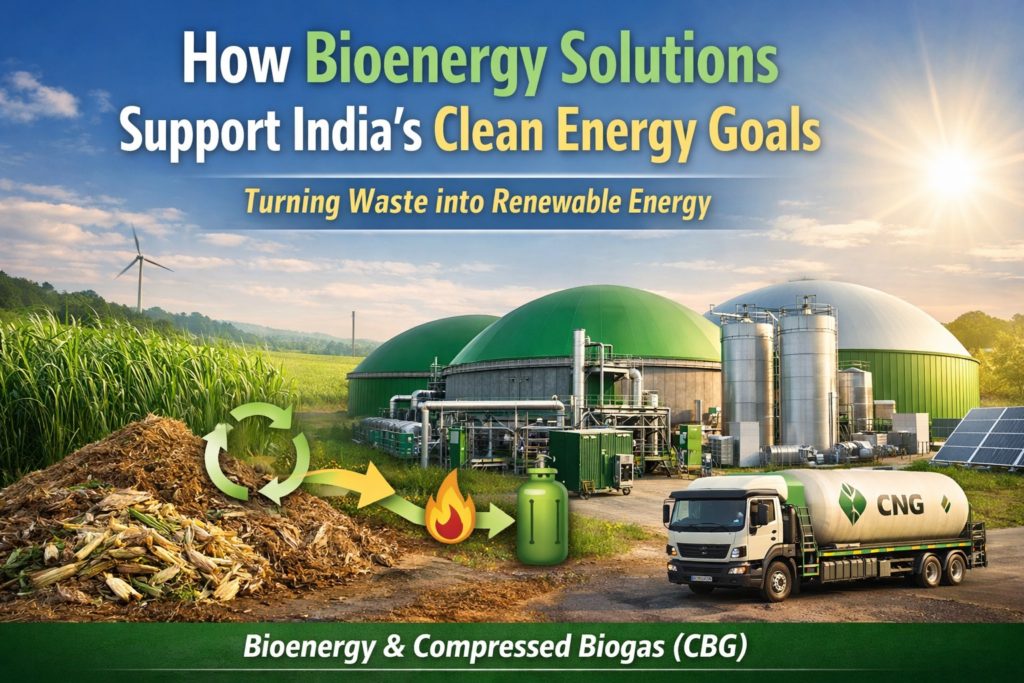
The growth of industries and cities poses a significant problem. The two significant problems are how to manage the increasing amount of waste and how to control the increase in carbon emissions. The conventional source of fossil fuels may not be sufficient to meet the increasing demands of the country without harming the environment. This is the area in which the role of bioenergy is important in the clean and green future of India.
Bioenergy in the form of compressed biogas is converting waste into a resource. India has tremendous opportunities to produce clean fuel out of waste. Organic recycling systems are playing a significant role in making this shift from conventional fossil fuels to clean and renewable fuels a success.
What Are Bioenergy Solutions?
Bioenergy solutions are defined as those technologies that can convert waste materials such as agricultural waste, waste materials in cities, and energy crops into energy forms such as biogas, electricity, and biofuels.
India is seeing strong growth in CBG plant engineering and design, with every CBG plant EPC company India focusing on scalable and efficient systems. A Compressed Biogas Plant Manufacturer in India helps build infrastructure that converts biomass into clean fuel.
At the core of these systems is biomass to CBG, where waste is processed using advanced methods like dry anaerobic digestion systems India and upgraded using CBG purification technology to produce high-quality fuel.
The Role of Bioenergy in India’s Clean Energy Mission
India’s ambitious renewable energy goals and the long-term vision for net-zero are made possible by bioenergy, helping to tackle three core challenges – waste management, clean fuels, and emissions reduction.
Various Government schemes like the SATAT scheme etc. are speeding up this adoption and several CBG projects under the SATAT scheme are being developed by each SATAT scheme CBG developer to help industry infuse sustainable mobility using biogas.
Unlike solar and wind energy, bioenergy provides continuous energy generation. This makes it reliable for industrial use. It also supports green energy from municipal waste, helping cities manage waste more efficiently.
From Waste to Wealth: The Power of Feedstock Innovation
One of the most important developments in bioenergy is the use of high-yield feedstock and agricultural residues.
Compressed Biogas from Napier Grass is gaining attention due to its high productivity. It is considered one of the best crops for CBG production. Napier grass for biogas ensures consistent supply and better output. Research like ORS Napier grass R&D focuses on improving Napier grass biogas production and identifying high yield feedstock for CBG.
Technologies such as Paddy Straw Hydolysis and bioenzyme for pretreatment of agri residue help convert crop waste into energy. This enables large-scale production of CBG from agricultural waste and CBG from biomass waste.
In urban areas, innovations like MSW torrefaction and biomass torrefication convert municipal waste into fuel. This helps cities reduce landfill burden and generate energy.
New technologies are driving the growth of bioenergy.
India’s bioenergy sector is evolving with advanced technologies that improve efficiency and output.
Innovations like BM-Alg Technology and Biological Carbon Capture and Utilisation system BioCCUS help produce cleaner energy while capturing carbon emissions. Modern plants also use CBG plant automation solutions to improve performance and reduce operational costs.
With better CBG yield optimization and improved CBG plant process design, plants can achieve higher output with lower input. New pathways like biomass to rDME and biomass to Sustainable Aviation Fuel SAF are also expanding the future of bioenergy.
Bioenergy vs Fossil Fuels
| Factor | Bioenergy (CBG) | Fossil Fuels |
| Source | Organic waste and biomass | Non renewable resources |
| Emissions | Low emissions | High emissions |
| Waste Management | Converts waste into energy | Creates pollution |
| Sustainability | Renewable and scalable | Limited and depleting |
| Rural Impact | Supports farmers and rural income | Limited impact |
| Energy Security | Reduces imports | High dependency |
This clearly shows why bioenergy is becoming essential for India’s energy future.
Industrial and Rural Impact
Bioenergy is good for both businesses and rural areas.
Farmers can supply feedstock like agricultural waste and bioenergy crops for biogas. This reduces stubble burning and creates additional income. Industries benefit from turnkey CBG plant solutions that help reduce energy costs and improve sustainability.
A reliable engineering company for CBG ensures smooth project execution from design to operation.
Organic Recycling Systems: Enabling Bioenergy in India
Organic recycling systems is playing a major role in India’s clean energy transition. As a waste to energy cleantech company India, organic recycling systems has delivered multiple ORS EPC biogas plant projects across the country.
With expertise as a CBG technology company in India, organic recycling systems focuses on complete solutions including feedstock R&D for compressed biogas, plant engineering, and optimization.
Many successful organic recycling systems projects demonstrate how scalable and efficient bioenergy solutions can be implemented for industries and municipalities.
Conclusion: Bioenergy is the Future of Clean Energy in India
India is finally beginning to enter an age where sustainability and growth will be shared allies. Bioenergy is the answer to this conundrum; reducing waste to clean fuel and keeping emissions in check.
India is slowly moving forward with its energy sector to make it more sustainable and reliable with the proper policy, and increased CBG plant technology adoption. Companies like organic recycling systems will be at the centre of this development and growth.
Bioenergy is no longer an alternative; it is becoming an integral part of the clean energy policy in India.
FAQs
Q. What is Compressed Biogas?
Compressed Biogas (CBG) is a clean-burning green fuel that is essentially untreated biogas derived from organic matter – food, agricultural & forestry residue and animal waste, purified of impurities. After the processing, it becomes free of impurities and is distributed and used the same way as natural gas, for cooking, vehicle tank and industrial purposes.
Q. How does bioenergy boost clean energy development?
Bioenergy helps make the future cleaner by using organic waste to cut down on the use of fossil fuels, lower greenhouse gas emissions, and encourage the use of green energy.
Q. What is the ideal feed stocks of biofuels for CBG?
Napiergrass and agricultural waste (also known as crop residue or agricultural residues) and municipal waste are preferred as feed substances for CBG because they are accessible and provide high biogas productivity.
Q. What is the SATAT scheme?
SATAT (Sustainable Alternative Towards Affordable Transportation) Scheme is a GOI scheme to promote entrepreneurs to produce and use compressed biogas as a green fuel for vehicles and other applications and reduce pollution.
Q. Why Organic recycling systems?
Organic recycling systems uses advanced technology to produce energy from waste. We are committed to providing the right solution from technology to implementation and take the risk and the headache out of your bioenergy project.
Take the Next Step Towards Clean Energy
If you want to reduce energy costs, manage waste efficiently, and support sustainability goals, this is the right time to act.
Organic recycling systems provides complete solutions from CBG plant process design to execution of large-scale ORS EPC biogas plant projects.
Visit Us:
Office No. 1003, 10th Floor, The Affaires, Plot No. 9, Sector 17, Sanpada, Navi Mumbai – 400705
Get in Touch:
Email: info@organicrecycling.co.in
Phone: 022-41702222
Work with Organic Recycling Systems to move toward energy solutions that are better for the environment. We can turn trash into treasure and make the world cleaner and greener.
Leave a Reply