

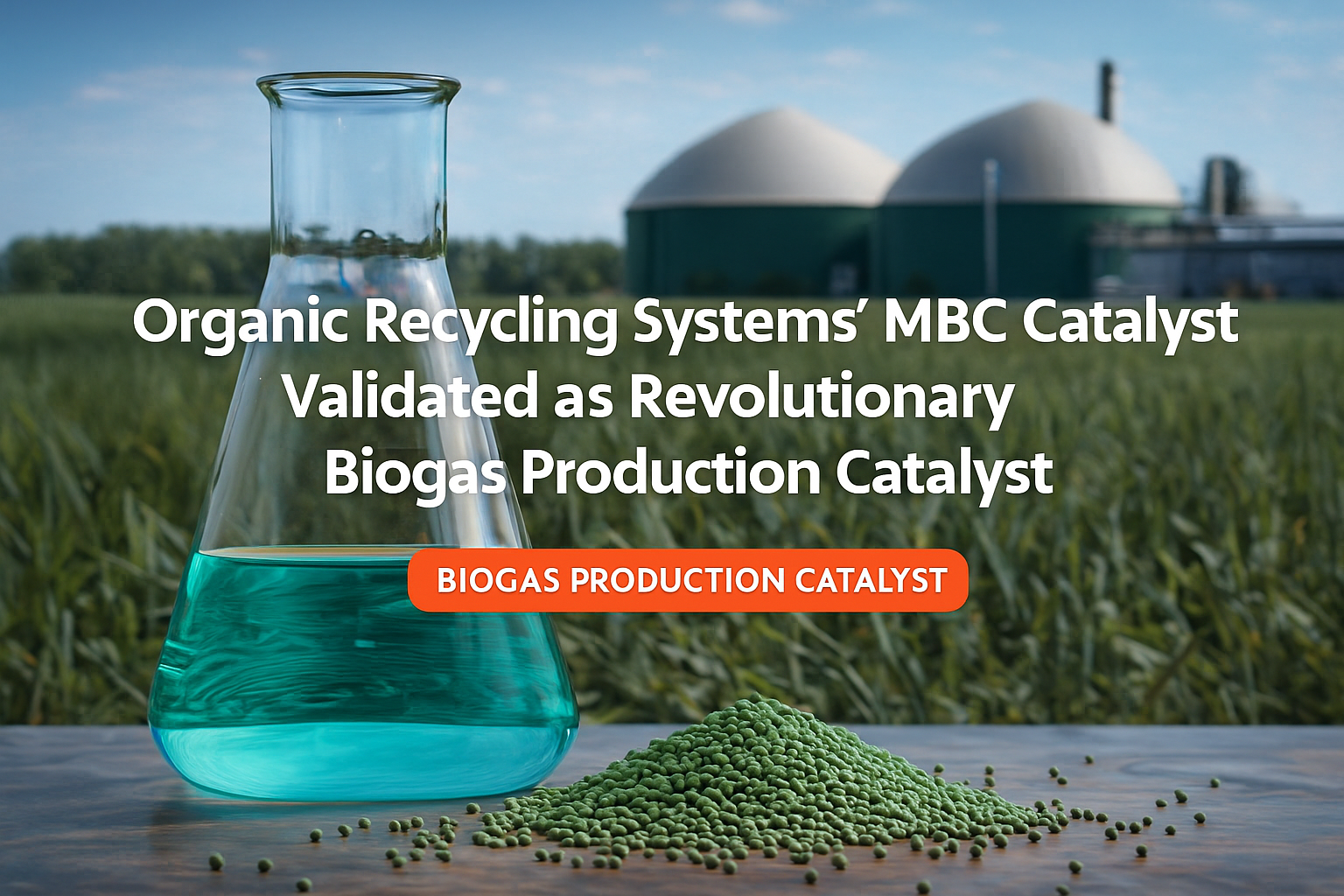
MBC Catalyst for Biogas Production
Organic Recycling Systems (ORS) has taken a major leap forward in advancing India’s bioenergy sector. With global pressure mounting to transition toward cleaner, more circular energy solutions, ORS’s newly validated MBC (MethanoBoost Catalyst) is emerging as a transformative innovation in the world of anaerobic digestion and biogas generation.
Recently validated by the Sardar Swarn Singh National Institute of Bio-Energy (SSS-NIBE)—India’s premier bioenergy research institution—the MBC catalyst has demonstrated the ability to increase methane yields by up to 30%. This breakthrough was covered in detail by BioEnergy Times, which reported on ORS’s milestone achievement here:
👉 https://bioenergytimes.com/organic-recycling-systems-catalyst-validated-for-boosting-biogas-production/
A New Era for Biogas Efficiency
At the heart of the MBC catalyst lies a proprietary nano-formulated solution engineered to enhance the conversion of carbon dioxide (CO₂) into methane (CH₄). In traditional anaerobic digestion, a significant portion of biogas content remains as CO₂, limiting energy output. MBC boosts the performance of methanogenic microbes, accelerating and stabilizing the digestion process.
Key performance gains include:
- Up to 30% increase in methane production in laboratory and pilot-scale studies
- More stable digester operations, reducing fluctuations that commonly affect plant performance
- Improved feedstock breakdown, especially for agricultural residues like Napier grass and paddy straw
- Enhanced digestate quality, resulting in a superior organic fertilizer output
This combination of increased energy yield and improved by-product value positions MBC as a catalyst that improves both process economics and environmental impact.
A Solution Tailored for India’s Biomass Potential
India produces over 600 million tonnes of agricultural residue each year, much of which is burned, contributing to severe air pollution and carbon emissions. Converting these residues into compressed biogas (CBG) offers a win-win opportunity—but only if the digestion process is efficient enough to handle lignocellulosic feedstocks at scale.
The MBC catalyst directly addresses this challenge.
In trials focusing on crop residues, the catalyst significantly improved biogas yield, making it easier and more attractive for plant operators to adopt these underutilized biomass resources. This aligns seamlessly with India’s goals under the SATAT (Sustainable Alternative Towards Affordable Transportation) initiative, which aims to dramatically expand CBG production nationwide.
Driving a Circular, Low-Carbon Future
ORS has long been a pioneer in waste-to-energy solutions, and the MBC catalyst builds on its vision of a circular economy where waste streams become energy, fertilizer, and economic opportunity.
The benefits extend far beyond plant operations:
- Reduced feedstock demand for the same energy output
- Lower greenhouse gas emissions per unit of biogas produced
- Greater profitability, enabling more projects to become commercially viable
- Better resource efficiency, contributing to national sustainability goals
By improving digestate quality, MBC also supports regenerative agriculture. Farmers gain access to nutrient-rich, organic fertilizer derived from clean, stabilized digestate—closing the loop between energy and agriculture.
What’s Next for ORS?
With validation from SSS-NIBE and strong early pilot results, ORS is poised to scale MBC deployment across India’s growing biogas and CBG sector. The company aims to collaborate with plant developers, agricultural stakeholders, and government programs to bring reliable, high-yield biogas production to the forefront of India’s green energy transition.
The potential is enormous:
- Higher methane yields
- Improved plant economics
- Cleaner air and reduced crop-residue burning
- Stronger rural and agricultural ecosystems
ORS’s MBC catalyst isn’t just boosting biogas production—it’s redefining what’s possible.
Connect with Organic Recycling Systems
📞 Contact: 022-41702222
✉️ Email: info@organicrecycling.co.in 💼 Connect with Us on LinkedIn!
1. What types of feedstock can be used in an anaerobic digester for biogas production?
Anaerobic digestion systems can process a wide variety of feedstock, including agricultural waste, paddy straw, biomass waste, Napier grass, Super Napier grass, segregated organic waste, municipal waste, crop residue biomass, and industrial waste. These materials serve as excellent sources for biogas, biomethane, and bio-CNG in a biomethanation plant or CBG plant in India.
2. How does an anaerobic digestion process work in a biogas plant?
The anaerobic digestion process is a biological breakdown of organic matter by microbes in the production of biogas. Key biogas production process steps include:
-
Feedstock preparation and waste segregation
-
Hydrolysis
-
Acidogenesis
-
Methanogenesis
This process produces biogas, digestate, and biomethane, supporting green energy and renewable energy solutions.
3. What is the role of catalysts like ORS MBC Catalyst in biogas production?
Catalysts improve biogas output by stabilizing the digestion process, enhancing microbial activity, and enabling higher methane yield. They are especially effective for tough biomass feedstocks such as Napier grass, paddy straw, and organic residues, and they support waste and biomass valorization.
4. How do biogas plants contribute to sustainable waste management in India?
Biogas plants support solid waste management, waste processing, dry waste segregation systems, material recovery facilities, transfer stations, and windrow composting. They convert biomass and waste to energy, reducing landfill loads and generating renewable green energy such as bio-CNG and biomethane gas.
5. What are the benefits of using Napier grass or Super Napier as biomass feedstock?
Napier grass seeds and Super Napier grass are high-yield bioenergy crops with significant bioenergy potential. They are excellent feedstocks for biogas from Napier grass, offering stable yields for CBG production plants and supporting India’s SATAT scheme for Compressed Biogas (CBG) Plants.
6. What engineering services are needed for setting up a biogas plant?
A complete biogas plant or bio-CNG plant setup typically requires:
-
Feasibility report and CBG plant project report
-
Engineering services, PMC services, and EPC services
-
Mixing arrangement, digester design (mesophilic or low-solid digester)
-
Gas valves, pressure monitoring, and digestate systems
-
Adjustable waste screening systems and waste separators
Experienced engineering companies and biogas plant manufacturers in India provide end-to-end solutions.
7. What consulting and laboratory services are required for biogas projects?
Biogas developers often need:
-
Biogas consultancy services
-
Waste audit for municipal, industrial, and agricultural waste
-
Laboratory services for feedstock testing
-
CBG plant feasibility studies
-
Waste reclamation and recycling strategies
These services help determine the quality of biogas feedstock, digester performance, and economic viability.
8. What are the factors affecting biogas production in an anaerobic digestion system?
Key factors include feedstock composition, temperature, hydraulic retention time, mixing efficiency, anaerobic digestion wastewater treatment needs, and the use of bioenzymes or catalysts. These influence the biogas production equation, methane yield, and overall stability.
9. What is the role of sustainable aviation fuel in the waste-to-energy ecosystem?
Sustainable aviation fuel companies, including those in India, increasingly use biomass energy, agricultural waste, and municipal waste biomass as biodiesel feedstock or bioethanol production sources. Technologies such as waste-to-energy and biomethanation of agricultural and municipal wastes offer low-carbon pathways for the global sustainable aviation fuel sector.
10. What is digestate, and how is it used?
Digestate is the nutrient-rich by-product of an anaerobic digestion system. It is used as:
-
Organic fertilizer
-
Soil conditioner
-
Compost via in-vessel composting or bio composting technology
It plays an important role in agricultural waste management techniques and reduces dependence on chemical fertilizers.
11. How do waste management companies in India support sustainable waste management?
A waste management company or waste recycling company in India typically provides:
-
Organic waste recycling
-
Recycling technologies
-
Waste recovery
-
Industrial waste treatment
-
Sustainable waste management systems
These organizations enable the conversion of biomass feedstock and agricultural waste products into renewable energy from agricultural waste.
12. Is biogas a renewable source of energy?
Yes, biogas is a renewable source of clean energy generated from organic waste. In contrast, natural gas is a non-renewable resource, though some discussions revolve around the blending of biomethane with natural gas.
13. What is the cost of establishing a CBG plant in India?
CBG plant cost in India depends on:
-
Type of feedstock (biomass, agricultural waste, municipal waste)
-
Capacity of the biogas production plant
-
Technology used, such as dry anaerobic digestion or low-solid digesters
-
Requirements handled by engineering companies in Mumbai and other regions
A detailed feasibility report or CBG plant project report provides accurate cost estimates.
14. How do waste segregation and dry anaerobic digestion systems improve waste processing?
Dry anaerobic digestion is ideal for high-solid biomass feedstock, municipal waste, and agricultural residues. Combined with dry waste segregation systems, adjustable screening systems, and material recovery facilities, these technologies maximize resource recovery and reduce landfill burden.
15. What is the role of Organic Recycling Systems in the green energy sector?
Organic Recycling Systems is a green energy company in India specializing in biogas plant manufacturing, waste processing plants, anaerobic digestion technology, consulting services, laboratory services, waste audits, and waste-to-energy technology. They support CBG plants, biomethanation processes, and agricultural waste recycling in India.