

How City Compost Fertilizer Can Improve Soil and Help Farmers Grow Better Crops
Proper management of municipal waste and domestic waste has increasingly become an important issue in rapidly growing cities. Vegetable peels, food waste, garden waste, and other forms of degradable organic materials are usually mixed with the municipal waste and then discarded. But the truth is that most of such waste could be made productive if managed properly. With appropriate collection and processing, it could become a valuable resource for agricultural and landscape uses. Here comes the city compost fertilizer.
There is no need to let the organic waste go to waste. Municipalities and waste managers can transform the organic waste into compost, which will contribute to organic material returning back to the soil. The city compost fertilizer is a perfect link between waste management in the cities and agricultural resources management.
Organic Recycling Systems is the company that specializes in sustainable resource recovery and organic waste processing. Knowledge of the way the compost is made, its applicability to agricultural use, and planning of the composting facility could help the company to make the right decision concerning waste management.
What Is City Compost Fertilizer?
Organic compost city fertilizer is an organic soil conditioner derived from the degradation of appropriate organic waste materials of the urban environment. Common sources of raw materials for this fertilizer include vegetable waste, fruit skins, food waste, leaves, garden waste, and other compostable materials collected from residences, markets, and open spaces.
The production of the compost does not involve only decomposition of the waste materials. They have to be sorted out from non-biodegradable waste such as plastics, glass, metals and other materials that cannot be included in the process.
If the production process is done properly, the fertilizer will include organic materials and various amounts of nutrients needed for plant growth. The composition will depend on the source material and the process of degradation. That is why it is necessary to test the quality of the product before its delivery to farmers or landscapers.
Why Is City Compost Important for Soil Health?
Everyone who is engaged in farming realizes the importance of soil condition for crops. Soil may be affected by continuous tillage, wrong agricultural activities, and low content of organic matter. Organic substances may be used as one of the tools for soil improvement.
The city compost is an organic fertilizer that helps to improve soil structure, moisture, and provides beneficial conditions for soil microorganisms. It is especially important to make such use of compost taking into consideration conditions of the soil and the crop.
The other benefit of using compost is the possibility to recycle municipal waste. Big amounts of degradable municipal waste are produced in cities that may be segregated and then turned into the useful substance for agriculture.
Nevertheless, compost cannot replace all other fertilizers. The farmer should realize the composition of compost and use it in the balanced soil fertility program.
How Is City Compost Manufactured?
The quality of the end product greatly depends on what is being brought to the processing facility. When there are too many plastics, glass, or any other impurities in the waste, their separation will become a very complex process that may influence the final compost.
The process of manufacturing usually involves sorting and separation. Organic waste, which is suitable for composting, must be sorted out, tested, and made ready for decomposition. In accordance with technological methods, material can be shredded and mixed, thus creating necessary conditions for decomposition.
Decomposition is based on the destruction of organic substance by microorganisms under the action of oxygen. It is necessary to control moisture, aeration, temperature, and the entire process of decomposition itself. After maturing, material can be sieved and prepared for quality tests.
City compost fertilizer is to be distributed for its purpose after the proper maturity and quality tests have been conducted.
City Compost and Fermented Organic Manure: What Is the Difference?
Though these two are commonly confused as being one and the same, both city compost and fermented organic manure cannot be said to be synonymous. These two may have similar origins, that is, organic waste management, but their manufacturing processes are different from each other.
City compost is always made by an aerobic process where microbes decompose organic matter in the presence of oxygen. The manufacturing process for fermented organic manure will either be fermentation or digestion, depending on the technology used.
The selection of the product to use is based on various factors like the feedstock, the processing plant, among others.
| Comparison | City Compost | Fermented Organic Manure |
| Production method | Aerobic decomposition | Biological fermentation or digestion-related processing |
| Common raw materials | Segregated municipal organic waste | Suitable biodegradable organic materials |
| Physical form | Generally solid compost | Depends on the processing method |
| Main purpose | Adding organic matter to soil | Supporting agricultural nutrient and soil management |
| Quality checks | Maturity, moisture, contaminants, and nutrients | Stability, nutrients, safety, and product composition |
Processing and evaluation is needed for both the products. Just because a product is named does not mean that it is good enough for agriculture.
Where Can City Compost Be Used?
City compost fertilizer has many other uses apart from conventional farming. For example, farmers may use the proper compost as one of the measures of soil management while nurseries, horticultural enterprises, parks, and landscaping companies might also be able to utilize it.
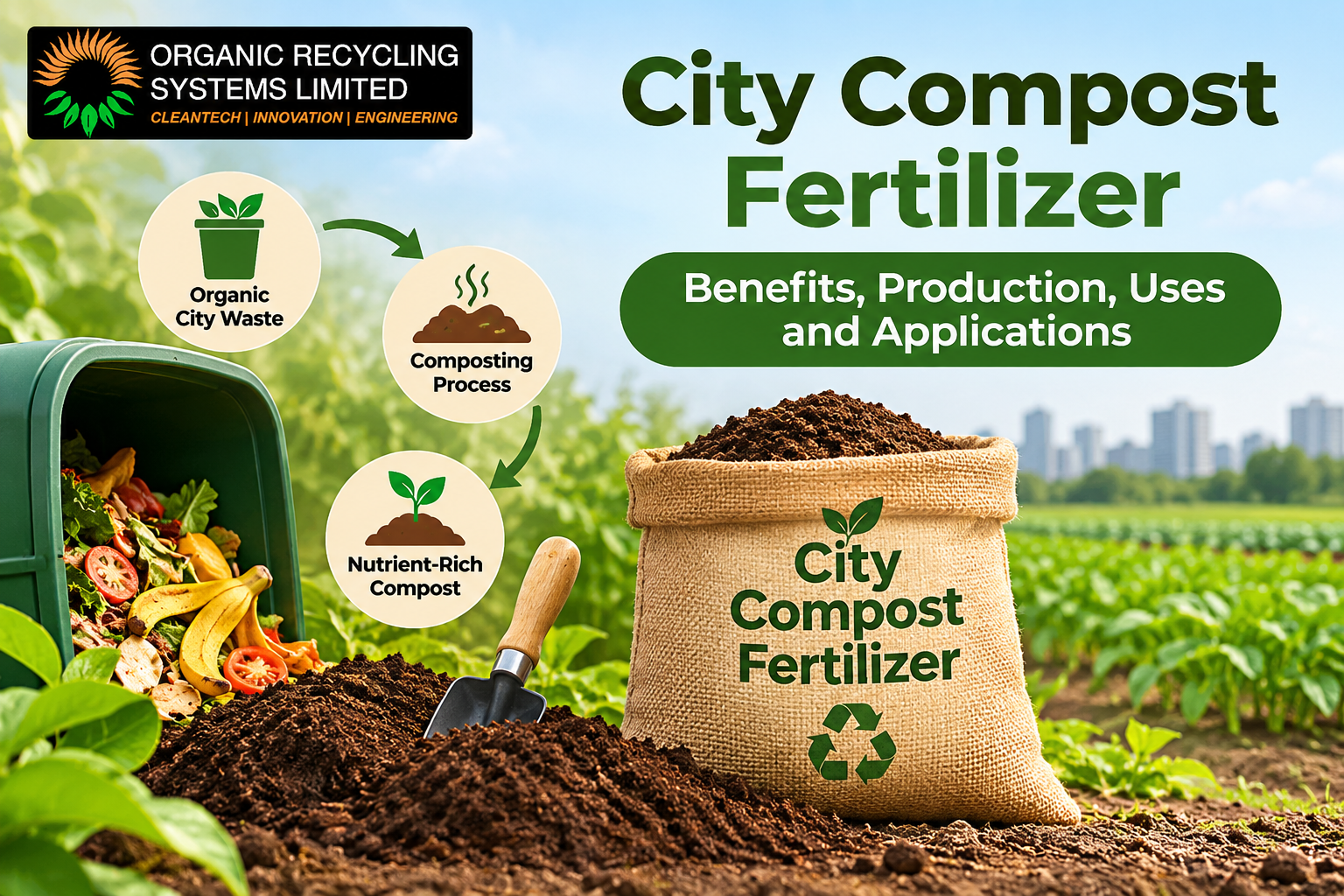
In agricultural farms, compost can be mixed into the soil as per the needs of the particular crop as well as the specific requirements of the product. In gardens and nurseries, it may be applied for increasing the organic matter in the proper growing medium. City administration can also use it in the maintenance of gardens and green areas.
Users of city compost fertilizer must be sure about its maturity, nutrient composition, and other quality aspects before using it. Application needs would depend on the crop, soil, and the intended purposes.
City Compost 50 Kg Price: What Should Buyers Consider?
Customers who are looking for city compost 50 kg price are advised to note that the price varies according to various conditions. There is no one fixed price applicable to all compost products.
This will depend on various elements such as the quality of the raw materials used, the processing method, screening, packaging, transportation, and the specifications of the manufacturer. A good quality product is expected to be produced under different circumstances from basic compost.
| Buying factor | What to check |
| Product quality | Maturity, nutrient content, and contamination levels |
| Packaging | Bag quality, size, and storage suitability |
| Processing | Segregation, composting, and screening practices |
| Transportation | Delivery distance and handling requirements |
| Supplier details | Product specifications and quality documentation |
| Order quantity | Retail or bulk supply arrangements |
In choosing the suppliers of city compost fertilizer, one should take into account more than the asking price; product quality is just as crucial.
Liquid Fermented Organic Manure and Other Organic Products
Another product that results from biological processing of appropriate organic materials is the liquid fermented organic manure. This differs from the solid compost in that the former is sold in liquid form, which may include soluble nutrients and other organic substances.
The composition of the product varies with the kind of raw materials and manufacturing processes used. Consumers need to understand all the information regarding the product, including its storage, quality, and the method of application.
Even though both products are linked with the conversion of organic wastes, the city compost fertilizer and the liquid fermented organic manure vary in terms of their physical characteristics and methods of handling.
A properly designed organic waste processing plant can result in different useful products.
What Makes a Good City Compost Manufacturing Facility?
It is necessary to do proper planning when setting up a composting facility. Just putting together the biodegradable waste and putting it in a pile does not guarantee a consistent end product. It requires a well-planned system of handling, separating, preparing, processing, and testing the product.
The city compost fertilizer production process must have the right infrastructure and operators as well as monitoring. Both moisture and aeration will be considered during composting and odor control and leachate will be important environmental aspects.
Proper technology should be selected based on the availability of waste. A technical feasibility study could help determine processing capacity, equipment, costs, and product quality among others.
Organic Recycling Systems specialises in sustainable resource recovery and organic waste processing. Professional planning would help organizations get the right approach of transforming biodegradable municipal waste into resources.
Get In Touch
Do you wish to start a municipality-based compost facility? We will assist you in having discussions regarding appropriate methods of recovering resources, taking into consideration your materials, aims, and technical needs.
Organic Recycling Systems
Office No. 1003, 10th Floor, The Affaires
Plot No. 9, Sector-17, Sanpada
Navi Mumbai-400705.
Phone: 022-41702222
Email: info@organicrecycling.co.in
Visit our LinkedIn Profile
Get in touch to discuss your organic waste processing and sustainable resource recovery requirements.
Frequently Asked Questions
What is city compost fertilizer?
It is an organic soil conditioner produced by composting separated biodegradable solid wastes using controlled composting method. It could provide organic matter and nutrients to the soil based on its quality.
Is city compost suitable for agricultural use?
Quality-controlled compost which has been matured properly may be utilized in agriculture based on the type of soil and crops.
What is the difference between city compost and vermicompost?
Compost of city origin is always prepared by the process of controlled microbial degradation, whereas vermicompost is prepared by the aid of earthworms.
Can fermented organic manure be used instead of city compost?
Both are distinct commodities whose suitability is dependent on nutrient composition, quality of processing, and use, among other factors.
What determines city compost 50 kg price?
Quality, packaging, processing, transport, specification requirements, and volume of the order may affect pricing.
Why is waste segregation important for compost production?
Segregation is useful in getting rid of plastics, glass, metals, and many other kinds of contamination before beginning the composting process.
Leave a Reply