

What Is the Process of Producing Renewable Energy and Organic Manure from Organic Waste Through GOBARdhan Scheme?
India is moving its priorities towards renewable energy, scientific farming, and scientific waste management. Organic waste, such as cattle waste, agricultural waste, food waste, and others, can be turned into wealth through proper technology. In the above context, the GOBARdhan scheme has helped by making the connection between organic waste and biogas, compressed biogas, and organic manure.
The GOBARdhan scheme provides the structure for exploring the opportunities for utilizing biodegradable waste for farmers, entrepreneurs, waste management companies, and renewable energy developers.
It helps the developers of projects to understand the GOBARdhan scheme guidelines, eligibility criteria, registration, and various other support structures to make an appropriate decision.
For organizations who are looking forward to developing biogas or compressed biogas projects, feasibility study and technical planning becomes extremely important.
What Is the GOBARdhan Scheme?
GOBARdhan stands for Galvanizing Organic Bio-Agro Resources Dhan. The initiative attempts to provide a means to convert bio-degradable waste into energy resources like biogas, compressed biogas, and organic manure. This initiative encourages the idea of a circular economy wherein waste could turn into an energy resource.
The GOBARdhan program facilitates the productive use of cow dung, crop waste and other organic wastes. Appropriate waste processing can transform these organic resources into energy and nutrient resources that can have use in agriculture.
It further links up sanitation, energy production, rural development and sustainable agriculture through the processing of organic waste.
GOBARdhan Scheme Benefits for Farmers and Businesses
There are various advantages of the GOBARdhan scheme for various entities in the organic waste and bioenergy value chain. While farmers can provide their cattle dung or agricultural waste, entrepreneurs and project developers can invest in facilities that will turn this organic matter into biogas, compressed biogas, and organic manure.
One of the key advantages is the effective utilization of biodegradable waste. Rather than letting the appropriate organic waste gather or be used ineffectively, a well-designed facility can transform this waste into valuable products. Such an approach can contribute to local waste management as well as the creation of renewable energy infrastructure.
Additionally, the GOBARdhan scheme can stimulate investments in biogas and compressed biogas projects as it allows connecting project developers to various government schemes and incentives. The existence of financial aid depends on a specific programme, its requirements, and approval process.
Cleaner environment due to productive utilization of organic waste and participation in resource recovery activities are advantages for farmers and rural populations. For businesses, it can serve as a starting point for implementing waste-to-energy projects.
GOBARdhan Scheme Eligibility
Eligibility for GOBARdhan scheme is dependent upon the nature of the project, registration category, any government scheme applicable, and the terms and conditions that come attached with the particular benefit being sought. It must be ensured whether one is seeking registration on the official portal or some assistance financially and technically.
The eligible participants may be organisations, entrepreneurs, and project developers working towards setting up or managing an appropriate biogas, compressed biogas or any other organic waste processing plant. All the requirements must be confirmed from the respective official portal and scheme guidelines.
Prior to the application, project developers should confirm the availability of feedstock, suitability of land, plant setup, technical feasibility, environmental requirements, and the documents required. Approval and permission for setting up such plants must be identified.
Registration does not ensure getting subsidies, loan guarantee, offtake, or any other form of financial assistance. Every facility has its own set of criteria and approval process. Studying the official guidelines will help to get an idea of the applicable provisions to the project.
GOBARdhan Scheme Subsidy and Financial Support
The subsidy provided under the GOBARdhan scheme is one of the most crucial elements to take into account when undertaking organic waste management and bioenergy projects. However, the type of assistance and its availability could differ based on the type of scheme, the type of project, eligible expenses, and executing agency.
Depending on the relevant government schemes, the projects could receive help in such areas as biogas technology, compressed biogas, marketing, financing, and organic manure promotion. It is necessary to make sure of the type of help available and its application procedure according to the latest notifications issued by the government authorities.
It cannot be assumed that all the registered plants would qualify for every type of assistance. The eligibility could be based on certain factors including the technical specification of the project, the project structure, finance, documents, and relevant guidelines.
The feasibility study should include the following aspects: cost of investments for the project, operational cost, feedstock logistics, technical equipment, use of gas, digestate disposal, and sources of income.
GOBARdhan Registration: How to Apply
The process of GOBARdhan registration is quite important for the plant operators and project developers who would like to register their projects via the corresponding government website. Depending on the project, there is a need to use a particular portal and registration category.
The general process includes creating the account of the authorized representative, verification of contacts, inputting the organization’s data and the information regarding the plant. It is important to make sure the information provided is correct and supported with the corresponding documentation.
It is necessary for the project developers to keep the registration data for further use. In case some additional documents are required from the project developer, he/she should provide them according to the instructions of the authority.
It is possible that the documentation process will vary depending on the category of the plant.
GOBARdhan Scheme for CBG Plants
The GOBARdhan scheme for CBG plants may be applicable to the developers who want to use biodegradable waste for producing compressed biogas. Compressed biogas can be obtained via the processing of appropriate raw materials in an anaerobic digester, which involves gas purification and upgrading steps.
To produce compressed biogas, one needs feedstock supply, a digesting system, gas cleaning facilities, a compressor, safety measures and digestate disposal methods. The feasibility of a CBG plant depends on the cost of operations, quality of the products, market reach and buyers’ availability.
While developing the GOBARdhan compressed biogas scheme, developers need to take into account the relevant technical standards, environmental provisions, financing provisions and relevant governmental programs. The developer of the project needs to make sure that he/she knows the current legislation in regard to his/her project.
Good project planning allows identifying the existing technical risks and choosing the best plant configuration and operation strategy.
GOBARdhan Biogas Plant and Waste Management
The GOBARdhan biogas plant can be found beneficial for the processing of cattle dung, agricultural waste, and other biodegradable wastes.
The bacteria digest organic waste under oxygen-limited conditions and produce biogas in the anaerobic digestion process.
This biogas can then be utilized for various energy purposes depending on its quality. Moreover, there is another byproduct from this biogas generation known as digestate which can contain useful substances as well. It is therefore essential to take care of it effectively considering the entire project.
Resource recovery is the strategy followed by GOBARdhan waste management where both organic waste processing and agriculture along with renewable energy are linked together. However, success of any such plant is highly dependent upon feedstock quality, process control, suitable equipment, trained personnel, and management of the end product.
All of these should be taken into consideration when designing the project.
GOBARdhan Organic Manure and Sustainable Agriculture
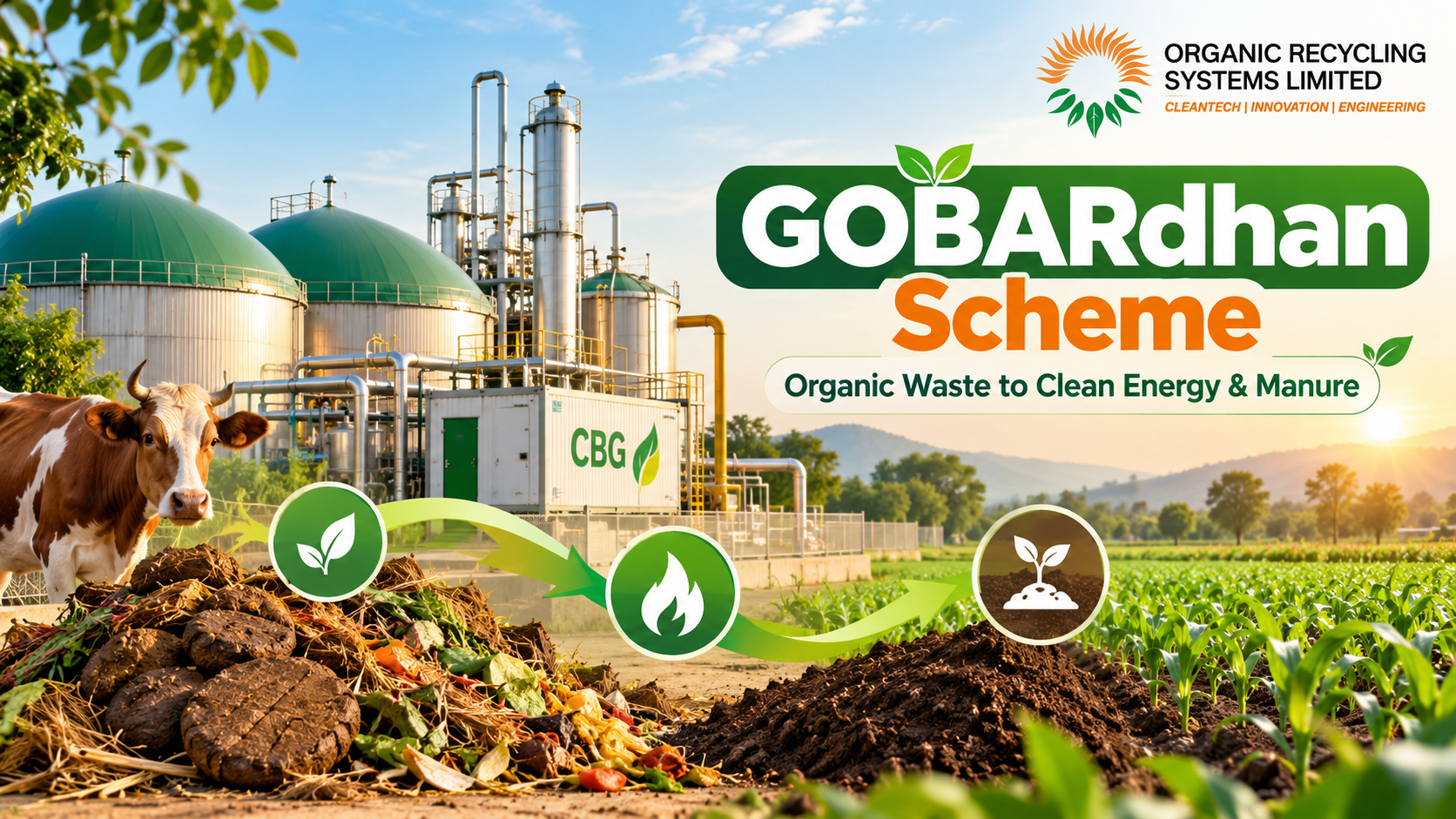
Organic manure is another possible output from organic waste processing. Digestate that is suitable for further processing can be converted into agricultural use products after proper treatment and quality testing.
Initiatives involving GOBARdhan organic manure will promote the main idea of returning nutrients to soil through biodegradable waste processing. Organic manure after proper treatment can supply organic material and nutrients to soils if it is suitable for this application.
However, it is wrong to consider organic manure as a ready-to-use product after biogas production. It can depend on many factors including feedstock used, technology of its processing, nutrient content, etc.
Biogas production and appropriate digestate management can promote better use of resources and link of waste processing and sustainable agriculture.
Why a GOBARdhan Project Report Is Important
Project report for GOBARdhan would assist in deciding the viability of a proposed biogas or compressed biogas plant. The following aspects must be evaluated in the process:
A project report provides an organisation with an opportunity to structure the information in a way that would be needed when talking to financiers, technology suppliers, government authorities, and potential buyers of the produced gas.
The report may reveal what approvals need to be obtained, what the risks associated with the project are and how a development strategy should be put together.
Professional project planning will ensure that the organisation avoids making the wrong technology decisions and wrong assumptions about operation of a future plant.
Organic Recycling Systems specialises in sustainable resource recovery and organic waste processing. Consulting with experienced technical professionals will enable the developer to assess the requirements of a biogas or CBG project.
Get In Touch with Organic Recycling Systems
If your company is considering GOBARdhan program implementation, planning a compressed biogas project, or studying various organic waste management technologies, our company will be able to provide you with useful insights into the technical planning of resource recovery projects.
We can provide an overview of feedstocks, technologies, plant specifications, project feasibility, and other relevant details about appropriate waste processing technologies.
Organic Recycling Systems
Office No. 1003, 10th Floor, The Affaires, Plot No. 9, Sector-17, Sanpada, Navi Mumbai-400705.
Email: info@organicrecycling.co.in
Phone: 022-41702222
Contact the team to discuss your project requirements and explore suitable organic waste processing and bioenergy solutions.
Frequently Asked Questions
What is the main objective of the GOBARdhan scheme?
The initiative will encourage the recycling of the biodegradable waste into valuable forms of energy like biogas, compressed biogas, and organic manure.
Who is eligible for GOBARdhan registration?
Eligibility is dependent on the category of plant, registration path, and guidelines. It is advised that project proponents refer to the official portal for details.
Does GOBARdhan registration guarantee a subsidy?
Not necessarily. Just registering will not automatically secure any financial aid. Each type of aid will have its own requirements and approval process.
How does the GOBARdhan scheme support CBG plants?
The scheme helps promote the general development of organic waste processing and production of bioenergy. Projects relating to the CBG program need to check the guidelines related to technical, business, environmental, and financial assistance.
Can a GOBARdhan biogas plant produce organic manure?
Yes, it is possible to convert digestate formed in the process of digestion into organic manure, under the condition that proper treatment and necessary quality criteria are satisfied.
Why is a project report important for a GOBARdhan project?
A project report enables one to evaluate the feedstock, technology, project location, investment needs, operating costs, permits, and project viability before its implementation.
Leave a Reply