

Sustainability has ceased to be a corporate buzzword. It is actively altering the dynamics of global trade. As nations race to combat climate change, the rules on businesses are becoming more stringent, thereby directly impacting international commerce. Europe is leading this change and is drafting carbon rules that will apply to how things are made, traded, and consumed across borders.
The European Union has framed a policy that has changed the face of competition for global manufacturers. Indian exporters must realize this. They must realize that failing to comply with these new environmental requirements can result in huge financial penalties and loss of access to the market. The introduction of the Carbon Border Adjustment Mechanism (CBAM) is a landmark in the history of Indian industries desiring to sell their goods in Europe.
This is now a basic requirement for all businesses in heavy manufacturing and export, to understand and, more importantly, undertake carbon accounting, emissions tracking, and strategic decarbonization. Indian exporters will be able to gain a competitive edge if, by the time these regulations are enforced, they are already aligned with them, while those who do not will be at risk of losing out on one of the most profitable markets in the world.
What is Carbon Border Adjustment Mechanism(CBAM)?
The CBAM acronym and its main aims must be clear for anyone to sail through these new waters. This policy is, in essence, a carbon tax on carbon-intensive imports into the EU. In India, the meaning of these CBAM provisions will materialize as a substantial trade barrier in the guise of an environmental measure.
The primary objective is the same as that of the existing EU Emissions Trading System to avoid carbon leakage, where firms would be encouraged to shift their production to a less environmentally stringent regulatory regime to avoid paying for their carbon emissions in the EU. With the levy of this tax, the EU ensures that the imported goods would bear a carbon cost akin to that of what the domestic European producers pay under the EU Emissions Trading System.
Carbon Border Adjustment Mechanism (CBAM) makes sure that the European industries do not suffer because of more stringent local environmental regulations by leveling the playing field. For Indian producers, this means that the carbon intensity of their production processes is now directly related to their export profitability. It makes them pay for the pollution they create.
How Carbon Border Adjustment Mechanism (CBAM) Works
The operational framework of the Carbon Border Adjustment Mechanism (CBAM) is systematic and strict. In the transitional period that began at the end of 2023, importers of targeted goods only have to declare their embedded emissions without making any payments in that sense.
But when the definitive period kicks in, importers have to buy and then surrender CBAM certificates which will correspond with the embedded emissions in their imported goods.
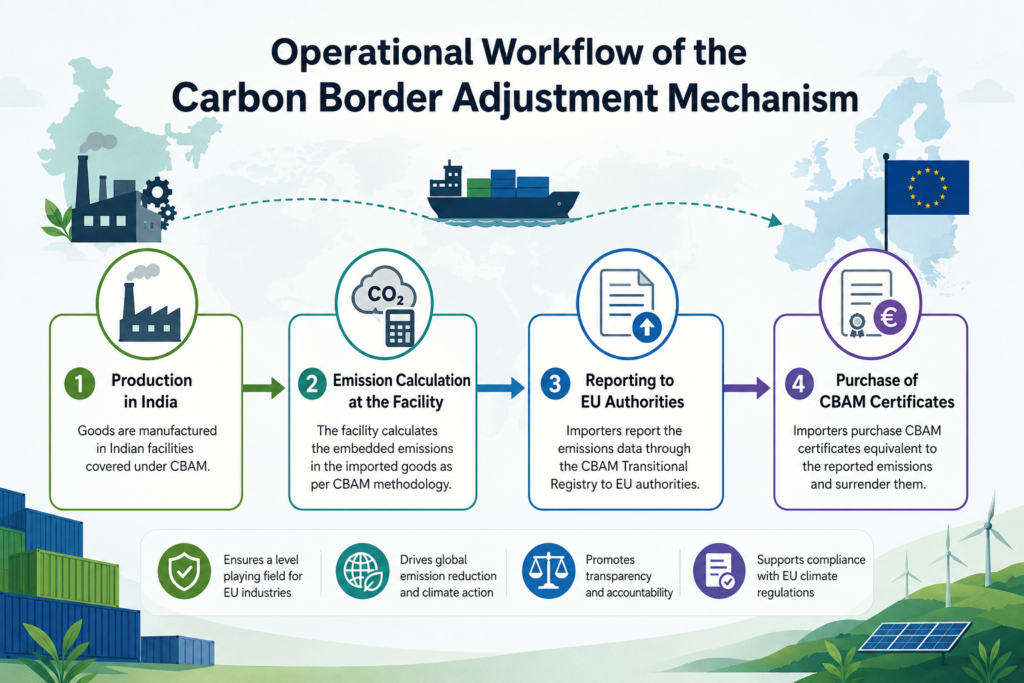
Imagine a real case of an Indian steelmaker who exports structural beams to Germany. Under the Carbon Border Adjustment Mechanism, the exporter has to calculate the exact tons of carbon dioxide emitted per ton of steel. This information is to be verified by an accredited body and then forwarded to the European importer.
Based on this information, the European importer purchases certificates at the existing EU carbon price. In case the Indian steelmaker can prove that they had already paid a carbon price in India for those specific emissions, then the cost of the certificates will be lower. To better grasp its financial implications, it helps to compare this policy with traditional taxation methods.
| Feature | Carbon Border Adjustment Mechanism (CBAM) | Carbon Tax |
| Scope | Applies strictly to specific imported goods into the EU. | Applies broadly to all carbon emissions within a specific jurisdiction. |
| Objective | Prevents carbon leakage and levels the playing field for EU industries. | Discourages carbon emissions by making polluting activities more expensive. |
| Price Determination | Linked directly to the fluctuating prices of the EU ETS. | Fixed price per ton of emissions, set by the government. |
| Revenue Usage | Revenue stays within the importing country (EU member state). | Revenue goes to the taxing government to be used as they see fit. |
| Target Audience | Foreign exporters and domestic EU importers of carbon-intensive goods. | Domestic industries, power plants, and fuel suppliers. |
Industries Covered Under Carbon Border Adjustment Mechanism (CBAM)
The regulation does not target every imported product. It specifically focuses on industries that are highly energy-intensive and at the greatest risk of causing carbon leakage. The primary sectors include:
- Iron and steel
- Aluminium
- Cement
- Hydrogen
- Fertilizers
- Electricity
This has a significant impact on Indian steel exports. India happens to be one of the largest steel producers in the world and the European Union is one of the major destinations for its exports. Due to the high carbon intensity of traditional blast furnace steelmaking, Indian steel exporters are immediately at risk of increased costs. The same will apply to the margins of the aluminium and cement sectors under the Carbon Border Adjustment Mechanism (CBAM) as they heavily depend on fossil fuels for extreme heat and chemical reduction.
Even the fledgling green hydrogen sector faces scrutiny. Heavy levies will be imposed if hydrogen is produced from natural gas without proper carbon capture. For Indian exporters in these sectors, the immediate priority is to be able to achieve CBAM compliance for Indian exporters; this will determine their future market share and operational continuity.
Carbon Assessment
To meet these rules, you must have a strong base in carbon accounting. The carbon footprint is the sum of all greenhouse gas emissions, both direct and indirect, that result from an organization, product, or event. The best way for a business to get started in understanding its exposure to European regulations is to work with a professional carbon footprint assessment company.
This involves a detailed calculation of product carbon footprint, from which the emissions related only to the manufacture of the exported product are identified. Most companies use a carbon footprint calculator for India based on grid emission factors and ground realities of manufacturing. But, in general, tools are not good enough for compliance. Carbon accounting has to be based on solid data collection covering energy consumption, raw material sourcing, and chemical processes.
This is where the formal GHG inventory preparation becomes critical. In other words, following the standards set by the GHG Protocol, reporting India means ensuring that every ton of emission is accounted for using internationally recognized methodologies. To present this same data to the European authorities without facing rejection, a business must secure carbon footprint verification services from an independent and accredited third party. Without this verification, the data will not hold any legal weight in the EU.
Scope 1 Scope 2 Scope 3 Emissions
Understanding the Emission Categories
An essential part of any carbon assessment is the classification of emissions. Knowledge of the Scope 1 2 3 emissions calculation India framework is compulsory for all exporters. Scope 1 emissions are those which are direct emissions from sources owned or controlled by the organization.
For example, in the case of a cement plant, this would include carbon dioxide emissions directly from the calcination process in the kiln. It also includes company-owned delivery trucks. The second scope is defined as all other indirect emissions from the generation of purchased electricity, steam, heating, or cooling consumed by the reporting company.
If a steel plant buys most of its electricity off a coal-heavy grid, then the impact of its emissions under scope 2 would be fairly large.
Why These Scopes Matter Under Regulations
The current proposal on Carbon Border Adjustment Mechanism includes provisions for the determination of the indirect and direct greenhouse gas emissions as prescribed in Scope 1 and Scope 2. Not calculating Scope 3 is a big strategic mistake. These are other indirect emissions not included in a company’s value chain upstream and downstream transportation.
Experts anticipate that as Carbon Border Adjustment Mechanism matures, these may be integrated into the reporting requirements, making it important to track comprehensively today because what will be a requirement soon is now an advantage if adopted early. Early adopters of full-scope tracking will have a massive strategic advantage.
How to Calculate CBAM Embedded Emissions
The technical process of calculating CBAM embedded emissions requires very careful detail. In the calculation, the first step is to identify the specific production processes used in making the good that is exported. For example, in steel manufacturing, the emissions of basic oxygen furnaces must be distinguished from those of electric arc furnaces since each route has a vastly different carbon profile.
Now, firms must collect data on all fossil fuels consumed, the electricity used, and any process-related chemical emissions. Emissions are calculated by multiplying activity data with standardized emission factors. Since this data determines financial liability under the Carbon Border Adjustment Mechanism (CBAM), accuracy is of utmost importance.
Many firms are currently investing in advanced carbon accounting software India to automate data collection and reduce human error during this sensitive phase.
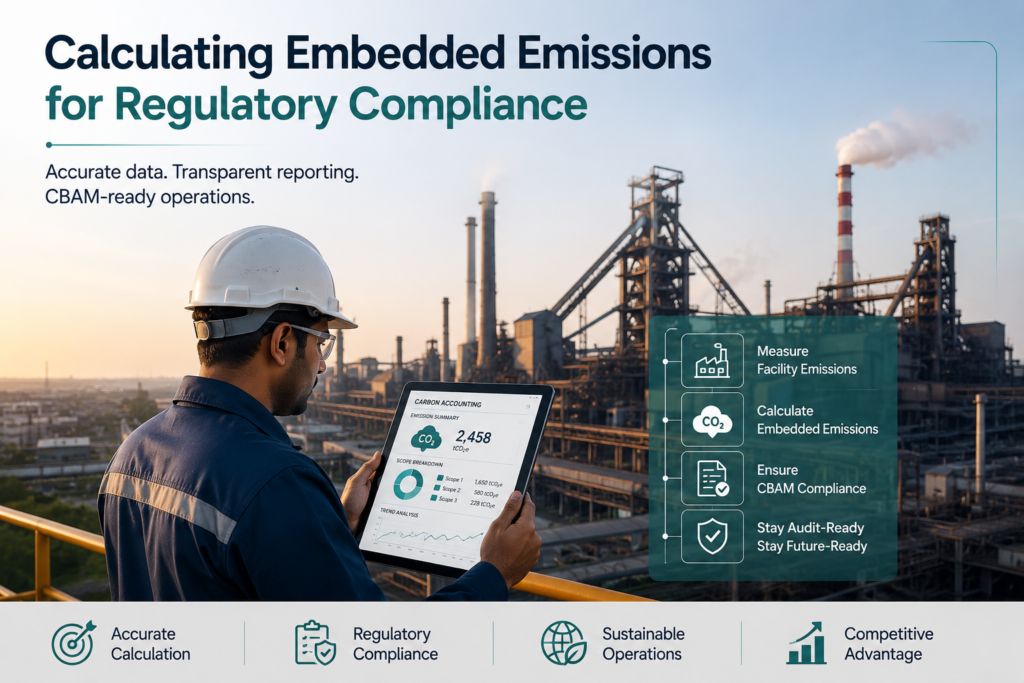
After the internal calculation is done, it has to be verified for carbon under ISO 14064 India. This standard offers guidelines for quantifying and reporting emissions of greenhouse gases. If the emission data is not verified under ISO 14064, European importers reject the emission data and force to use default EU emission values.
These values are generally much higher and lead to much higher certificate costs for the Carbon Border Adjustment Mechanism (CBAM), which hurts the Indian exporter’s bottom line.
CCUS
Carbon Capture and Storage Fundamentals
For heavy industries that cannot meet their emission reductions through energy efficiency, Carbon Capture, Utilisation, and Storage is their lifeline. To get the meaning of carbon capture and storage, one has to look at it as a two-part process. First, carbon dioxide is captured directly from the industrial flue gases before it enters the atmosphere. Second, it is transported via pipelines or ships to a permanent storage site deep underground or used to make commercial products.
Technological Advancements and Applications
CCUS is a critical technological bridge for sectors like cement and steel that cannot easily electrify. Carbon capture technology India is still in the early stages of advancement but is gaining momentum as regulatory pressures increase. Some of the first carbon capture companies India are piloting projects to retrofit existing plants with capture equipment. The use cases are very specific and fast emerging.
Cement Industry India is a particularly critical use case for CCUS because the chemical emissions from limestone calcination can’t be eliminated by simply moving to renewable energy. Similarly, the production of blue hydrogen CCUS India provides a lower-carbon alternative to grey hydrogen if the captured carbon is permanently sequestered. Looking forward, the CCUS policy India 2026 is expected to provide the requisite financial incentives and regulatory clarity to scale these projects.
Economic and Geological Challenges
While direct air capture India is still an expensive prospect for the removal of ambient CO2, industrial point-source capture is becoming more viable. The main challenge is still the cost of carbon capture per tonne, which currently ranges from $50 to over $150, depending on the industry and the maturity of the technology.
This cost must come down to make CCUS economically viable without heavy government subsidies. Also, assessing the overall storage capacity India has for CO2 is a geological challenge that needs extensive mapping of depleted oil fields and deep saline aquifers.
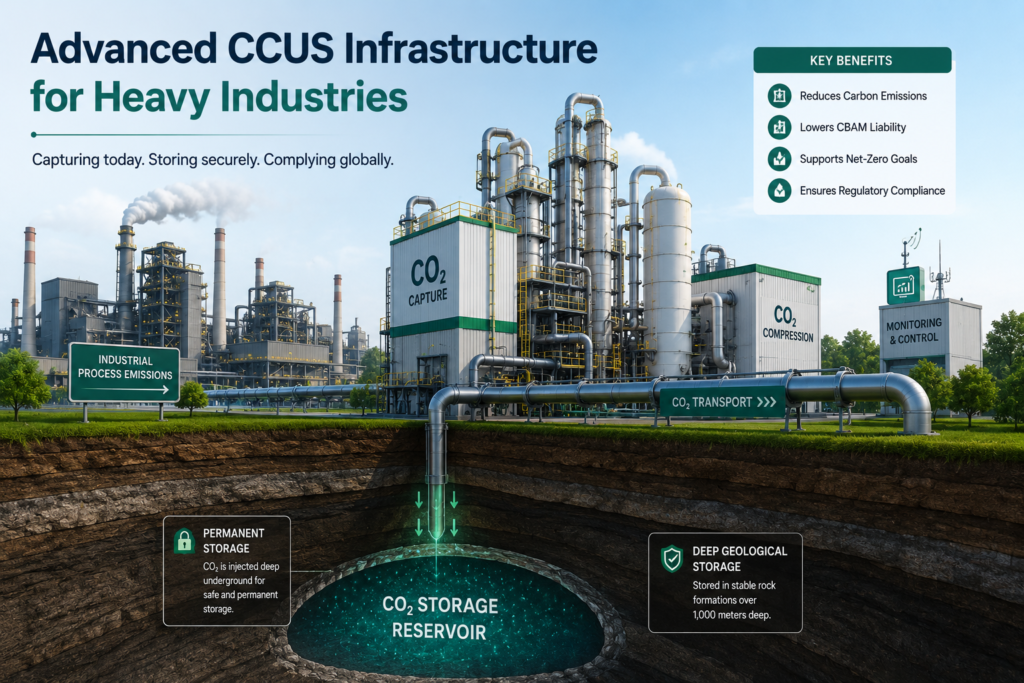
Integrating CCUS into your operations can significantly lower the embedded emissions of your exported products, directly reducing your financial liability under the Carbon Border Adjustment Mechanism (CBAM).
Green Chemicals
Yet another smart way would be to cut the carbon footprints of products by recasting raw materials. Green chemistry is defined as the design of chemical products and processes that cut or eliminate the use and generation of hazardous substances. This would be a sustainable solution in chemicals for the industry to lower its upstream Scope 3 emissions and improve safety in the working environment.
Green chemicals India companies are the main drivers of the growth of green chemicals in India. This is achieved through a switch from petrochemicals. These manufacturers develop products based on renewable feedstock chemicals like agricultural waste, algae, or corn starch instead of crude oil. High-carbon-input traditional industries can collaborate with bio-based chemicals manufacturers to substitute their high-carbon inputs with sustainable alternatives.
This will shield Indian exporters from the Carbon Border Adjustment Mechanism (CBAM) and make their product lines highly attractive to environmentally conscious European buyers. In fact, when an Indian exporter uses renewable feedstocks to produce intermediate goods for the European market, the embedded carbon footprint decreases sharply. Thus, the transition to sustainable chemical manufacturing makes the product line of Indian exporters immune to the CBAM by making it aligned with the broader EU Green Deal objectives.
Industrial Decarbonisation
Building a Net Zero Roadmap
In the end, making it through and doing well in a world that limits carbon takes a detailed long-term plan for changing how industries work to lower carbon. This starts with making a strong net zero plan for India that works well with how the facility actually runs. Right now, many of the best Indian companies that sell goods to other countries are working with a consultant that has a strategy for reaching net zero. They are doing this to plan out this hard change.
The Role of SBTi in Long-Term Strategy
SBTi target setting India would be the next phase of evolution in this journey. The Science Based Targets initiative is a program that shows companies a clear path of how to reduce greenhouse gas emissions in line with what the Paris Agreement is trying to accomplish. SBTi-validated targets tell European buyers that your company prioritizes long-term climate action and is not merely meeting the minimum requirements for compliance — which, in turn, builds immense brand trust.
Executing the Decarbonisation Strategy
A decarbonization strategy for India needs to be a blend of quick, medium, and long-term actions. These are immediate steps toward the maximization of energy efficiency and the procurement of renewable power. For the steel sector, drafting a decarbonization roadmap steel industry involves transitioning from coal-based blast furnaces to electric arc furnaces powered by green energy, or eventually adopting green hydrogen-based direct reduced iron.
In the meantime, a lot of firms are taking to a carbon neutral strategy India by buying premium carbon offsets to nullify unavoidable emissions. However, real industrial decarbonisation is based on actual, verifiable reductions within the manufacturing process and not just on offsets. The closer an industry gets to real net-zero production, the less its costs will be under the Carbon Border Adjustment Mechanism (CBAM).
Future of Carbon Border Adjustment Mechanism (CBAM)
Regulatory landscapes do not remain static. The future of CBAM is an expansion in both scope and severity. Industry experts expect that more product categories will be added to the list in the years to come, such as organic chemicals, polymers, glass, and downstream manufactured goods. Additionally, the financial effects will aggravate near the year 2026.
Stakeholders closely watch the CBAM certificate price 2026, which will be indirectly associated with the EU ETS carbon price but is expected to remain high because of the shrinking pool of free carbon allowances in Europe. This means the financial burden on the unprepared exporters will increase many times greater once the transitional reporting phase ends and actual payments begin. This challenge also presents massive Indian opportunities. Companies that invest in low-carbon manufacturing today will capture the market share left behind by carbon-intensive competitors.
Business readiness means more than merely installing new technology it’s about overhauling supply chain visibility, training staff in carbon accounting, and building strong relationships with European buyers who value green supply chains. The Carbon Border Adjustment Mechanism is essentially forcing a global industrial upgrade, and Indian manufacturers have the engineering prowess to lead this transition in the Global South.
Conclusion
The movement to carbon-aware trade is not going to be stopped. The rules in Europe are making a standard that other big countries, like the USA and the UK, will most likely match with their versions of the Carbon Border Adjustment Mechanism (CBAM).
For Indian industries, to see this as just a compliance exercise would be a missed opportunity. With a stringent carbon evaluation, and the study of new technologies such as CCUS, and the transformation into green chemicals, Indian exporters can turn a supposed trade hindrance into a reason for better operations.
The companies that manage to master their emissions data today will be the leading exporters of tomorrow, completely protected from future carbon tariffs and greatly favored by very sustainable global buyers. Expert navigation of the Carbon Border Adjustment Mechanism (CBAM) demands expert guidance, accurate data, and an unwavering commitment to reducing environmental impact.
Contact Organic Recycling Systems Ltd. for Expert Carbon Consulting
Are you an Indian exporter seeking to safeguard your European market share and reduce your risks under the Carbon Border Adjustment Mechanism (CBAM)? Carbon accounting, GHG inventories, and global verification standards are complex fields. You need specialized knowledge to navigate them.
Organic Recycling Systems Ltd. offers full-scope sustainability consulting and carbon consulting services designed for heavy industries. If you need a detailed carbon assessment, accurate carbon footprint mapping, comprehensive GHG inventory preparation, or a long-term industrial decarbonisation strategy, our environmental engineers will assist you from the start of data collection to ISO verification to keep your exports competitive and compliant.
Organic Recycling Systems Ltd.
Office No.1003, 10th Floor, The Affaires, Plot No.9, Sector-17, Sanpada, Navi Mumbai-400705
Phone: 022-41702222
Email: info@organicrecycling.co.in
Website: https://organicrecycling.co.in
Read our latest LinkedIn post on CBAM and its impact on Indian exporters.
Frequently Asked Questions
1. What exactly is the CBAM full form, and why does it matter to my business?
The full form of CBAM is Carbon Border Adjustment Mechanism. This holds significance as it is a new EU rule that imposes a carbon tax on goods imported, which will directly impact the profit of Indian exporters trading in steel, aluminum, cement, and other targeted sectors.
2. How would you describe the CBAM meaning in India in simple terms?
In simple terms, the CBAM definition in India is the carbon tax the European Union is levying on products made in India. If the making of your product involves high carbon emissions, you will practically pay a cost when exporting to Europe.
3. What steps are required for CBAM compliance for Indian exporters?
To be CBAM compliant, Indian exporters need to trace direct and indirect emissions, acquire strong carbon accounting tools, find the embedded emissions per product, and have these calculations verified by an accredited EU body.
4. What is the expected CBAM certificate price 2026?
Market forces will determine the exact rate but it’s expected that the CBAM certificate price 2026 would align quite closely with the EU ETS carbon price, which analysts project to range between €80 and €120 per tonne of carbon dioxide emitted.
5. How severe is the CBAM impact on Indian steel exports?
The CBAM impact on Indian steel exports is enormous because traditional steel making is highly carbon-intensive. Exporters using coal-based blast furnaces will face massive extra costs — pushing it to be all the more necessary to switch to electric arc furnaces or embrace carbon capture technologies.
6. Is there a simple way to understand how to calculate CBAM embedded emissions?
Calculating the CBAM embedded emissions involves the identification of all fossil fuels and electricity during the specific production process of the exported good, and then simply multiplying those amounts by the standardized emission factors – and subtracting any carbon prices already paid in India.
7. Why is ISO 14064 carbon verification India so important for this process?
This is because European authorities require third-party validation of your emission data. If you don’t have this particular verification, the EU will apply default high emission factors to your products — and that means unnecessarily high certificate costs.
8. Will the Carbon Border Adjustment Mechanism (CBAM) ever include Scope 3 emissions?
As of now, the Carbon Border Adjustment Mechanism (CBAM) covers only Scope 1 and Scope 2 emissions. In discussions with environmental regulators, there is a proposal to include Scope 3 emissions, which would mean that Indian exporters will have to trace and report on emissions through their entire supply chain, including extraction of raw materials.
Leave a Reply